
If you’ve been told you have an ACL tear, you’re probably asking: can an ACL tear heal without surgery? The short answer is — yes, in some cases. It depends on the severity of your injury, your age, and your activity level.
The Short Answer
Not all ACL tears are the same. A mild sprain may heal completely without surgery. A partial tear has a reasonable chance of healing with the right rehabilitation program. A complete tear typically won’t reattach on its own, but many people still regain full daily function through non-surgical treatment.
Can an ACL Tear Actually Heal Without Surgery?
A landmark study published in the British Journal of Sports Medicine found that 53% of ACL tears managed with rehabilitation alone showed healing on MRI within two years. Signs of healing appeared as early as three months. Patients whose ACLs healed through rehabilitation reported better sport function and quality of life than those who had surgery.
This means non-surgical treatment is a legitimate option for many people when guided by an experienced specialist.
ACL Tear Grades and Healing Potential
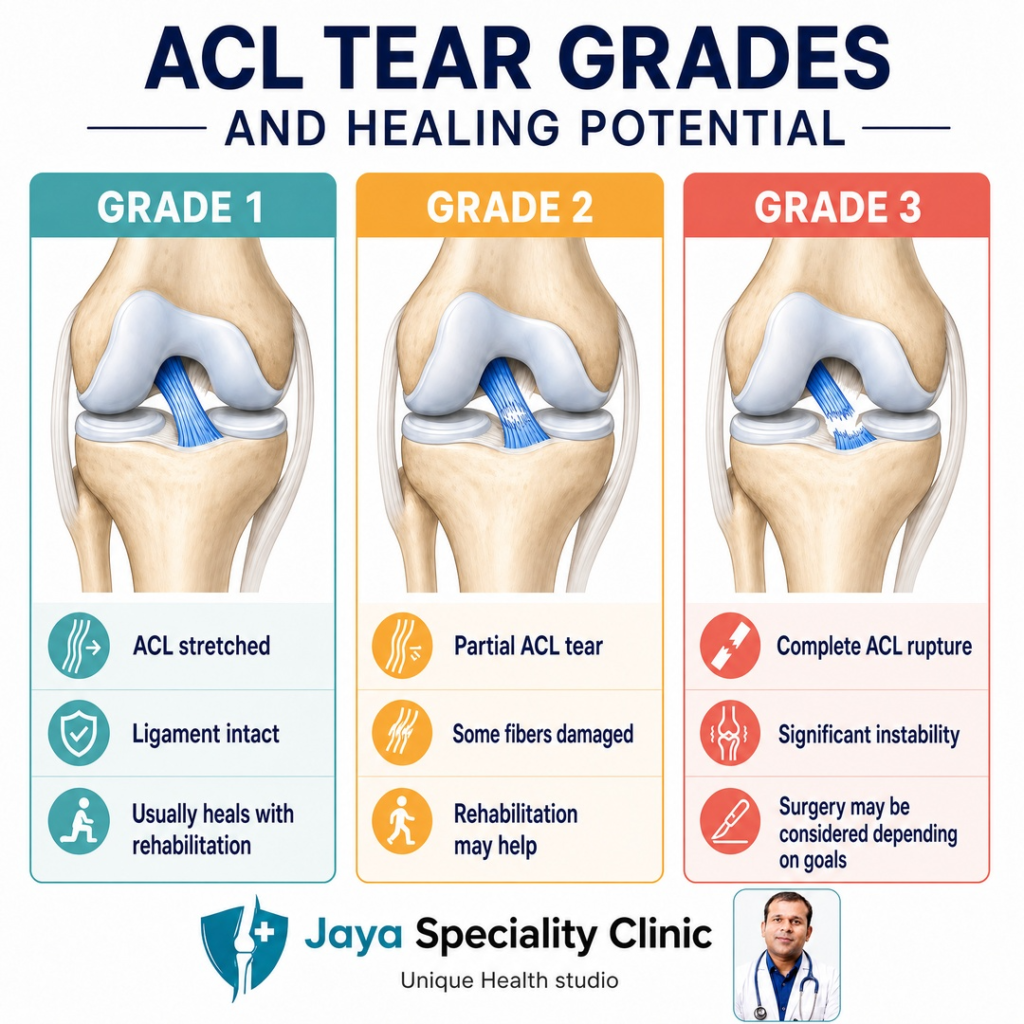
The severity of your tear largely determines whether it can heal without surgery.
| Grade | What It Means | Can It Heal Without Surgery? |
| Grade 1 | ACL is stretched but not torn | Yes — usually heals fully with rest and physiotherapy |
| Grade 2 | Partial tear of the ligament | Possibly — with structured rehabilitation and close monitoring |
| Grade 3 | Complete rupture of the ACL | Rarely — the ligament won’t reattach, but you can regain function through muscular compensation |
Our ACL & Ligament Injury Treatment in Chennai team has helped hundreds of patients recover from knee injuries using evidence-based methods. If you’ve torn your ACL, don’t assume surgery is your only option.
What Happens With a Complete (Grade 3) Tear?
A complete ACL tear won’t reconnect on its own. However, surrounding muscles — particularly the quadriceps and hamstrings — can compensate for lost stability when strengthened. Many people with Grade 3 tears return to daily activities without surgery. The trade-off is that pivoting sports remain risky.
Who Is a Good Candidate for Non-Surgical Treatment?
Not everyone should avoid surgery. Here’s a quick guide to who typically does well with non-surgical treatment.
| Factor | Good Candidate for Non-Surgical | Surgery Usually Recommended |
| Age | Over 45-50 years | Under 30 years |
| Activity level | Sedentary, walking, cycling, golf | Pivoting sports, cricket, football |
| Tear severity | Grade 1 or 2 partial tear | Grade 3 complete tear |
| Health conditions | Diabetes, heart conditions that increase surgical risk | Healthy with no surgical risk factors |
| Goal | Return to daily activities | Return to competitive sports |
Non-Surgical Treatment Options for ACL Tears
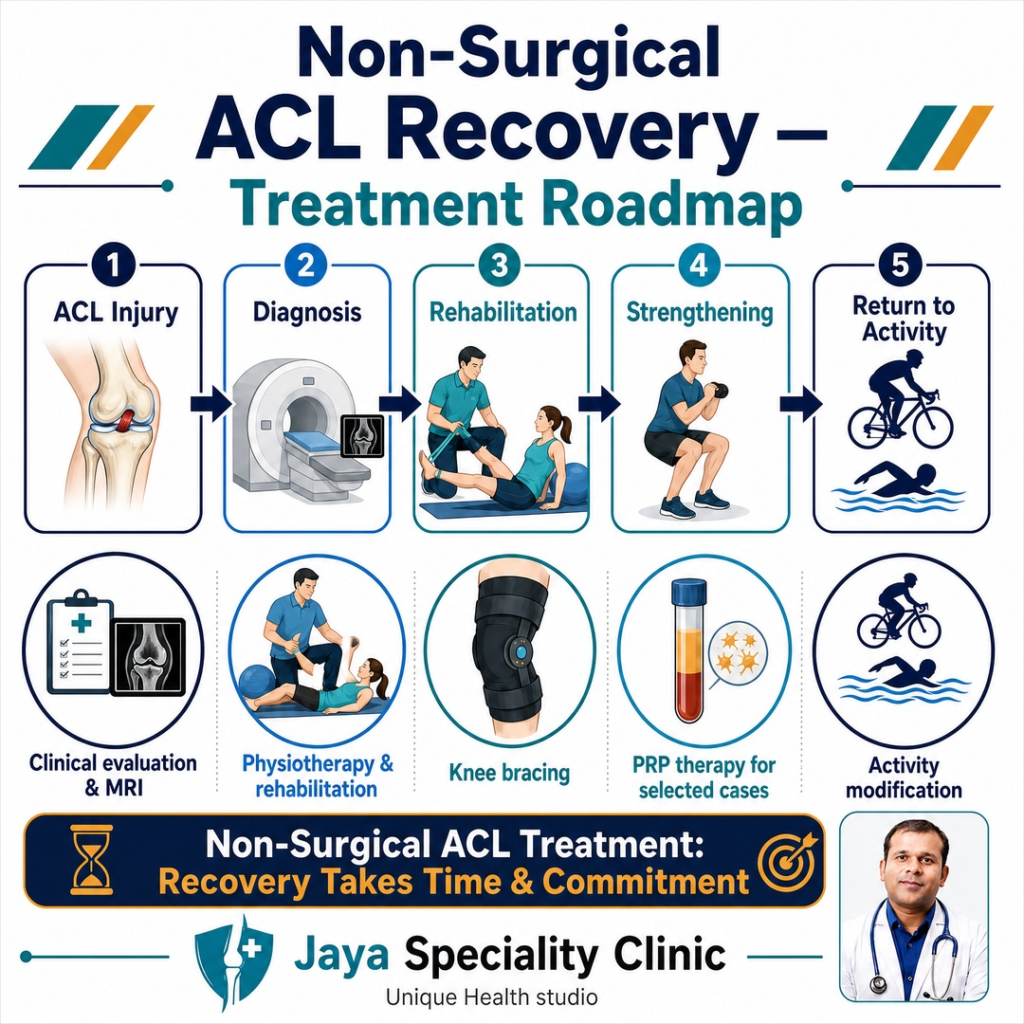
If you and your doctor decide on a non-surgical approach, here are the main treatment options.
1. Physical Therapy and Rehabilitation
This is the foundation of non-surgical ACL treatment. A physiotherapist designs a program focused on strengthening the quadriceps, hamstrings, and hip muscles that stabilize your knee. Therapy typically lasts 3-6 months.
2. RICE Protocol (Immediate Care)
In the first few weeks after injury, controlling swelling is critical through rest, ice, compression, and elevation (RICE).
3. Knee Bracing
A functional knee brace provides external support and prevents the knee from giving out during activities.
4. PRP Therapy (Platelet-Rich Plasma)
PRP therapy involves injecting concentrated growth factors from your own blood into the injured area, promoting natural tissue healing. For partial ACL tears, PRP therapy in Chennai at Jaya Speciality Clinic supports the healing process alongside physiotherapy.
5. Activity Modification
The key to long-term success is avoiding sports with sudden direction changes and choosing low-impact alternatives like swimming or cycling.
How Long Does Recovery Take Without Surgery?
Most people see significant improvement within 3-6 months. Daily activities (walking, stairs) resume within 6-8 weeks. Return to low-impact sports takes 3-4 months. Return to pivoting sports is unlikely without surgery.
Risks of Choosing Non-Surgical Treatment
Non-surgical treatment isn’t risk-free. Without a functional ACL, your knee is more vulnerable to meniscus tears, cartilage damage, osteoarthritis, and giving-way episodes.
When Surgery Is Still Necessary
Surgery may be necessary if you’re under 30 and want to return to pivoting sports, have a complete tear with ongoing instability, have combined injuries (meniscus + ACL), or fail to progress after 3-6 months of physiotherapy.
FAQ: ACL Tear Heal Without Surgery
Yes, in some cases. Grade 1 sprains heal fully. Grade 2 tears may heal with rehabilitation. Research shows 53% of rehab-managed tears showed healing on MRI within two years. Complete tears rarely reattach, but many regain daily function.
Most people see significant improvement within 3-6 months. Signs of healing can appear as early as 3 months on MRI. Daily activities resume in 6-8 weeks; low-impact sports take 3-4 months.
Yes. Most people with a torn ACL can walk. Grade 1 and 2 tears allow walking with minimal difficulty after inflammation subsides. Grade 3 tears may require a brace for support.
Without surgery, a complete tear won’t reconnect. However, with proper physiotherapy, most people regain functional strength and return to daily activities. Risks include meniscus damage and osteoarthritis over time.
Yes, partial tears have a reasonable chance of healing without surgery, especially with early physiotherapy, PRP therapy, and activity modification. The intact fibers maintain stability when surrounding muscles are strengthened.
At Jaya Speciality Clinic in West Mambalam, Chennai, we offer a conservative-first approach to ACL injuries. Our orthopedic specialists provide accurate diagnosis through clinical examination and MRI imaging, structured physiotherapy tailored to your goals, PRP therapy for partial tears, and non-surgical expertise to help you explore every option before considering surgery.
About Jaya Speciality Clinic
Jaya Speciality Clinic is a trusted Orthopedic Clinic in West Mambalam, Chennai, providing comprehensive care for ACL tears, ligament injuries, sports injuries, knee pain, and other musculoskeletal conditions. Led by Dr. Balachandar M, Senior Orthopaedic Surgeon, the clinic follows an individualized, conservative-first approach where appropriate. Patients are evaluated through clinical examination and imaging such as MRI when required, followed by a treatment plan based on the tear severity, activity level, and recovery goals. Non-surgical options may include structured physiotherapy, rehabilitation, knee bracing, activity modification, and PRP therapy for selected partial ACL injuries.
Conclusion
Can an ACL tear heal without surgery? It depends on the grade of your tear, your age, and your activity goals. Mild sprains heal well without surgery. Partial tears have a genuine chance of healing with the right rehabilitation. Complete tears won’t reattach, but many people regain excellent daily function through non-surgical treatment.
The key is getting an accurate diagnosis early and committing to a structured rehabilitation program. Don’t rush into surgery, but don’t ignore a torn ACL either. An experienced orthopedic specialist can help you find the right path for your specific situation.