
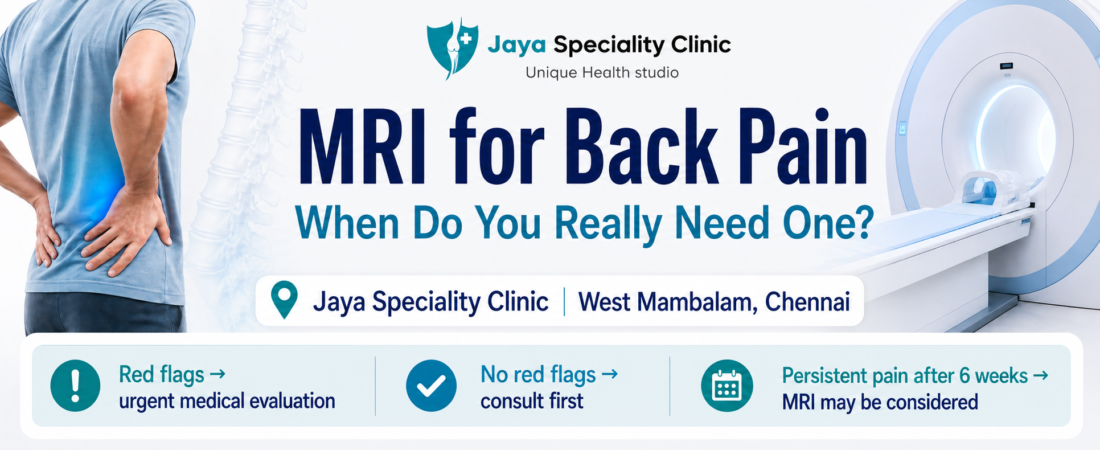
When it comes to MRI for Back Pain, one of the most common questions patients ask — and the answer might surprise you. Most people do not need an MRI right away. In fact, medical guidelines show that over 34% of MRI scans for back pain are ordered unnecessarily. The good news? You can make a smart decision about whether you need one by understanding when it is truly helpful and when it is just a waste of money.
This guide covers when an MRI is necessary, what it shows, Chennai costs, and smarter alternatives.
What Does an MRI for Back Pain Actually Show?

An MRI (Magnetic Resonance Imaging) uses powerful magnets and radio waves to create detailed pictures of the soft tissues inside your spine. Unlike X-rays, which only show bones, an MRI reveals the structures that are actually causing most back pain.
| Structure | What MRI Shows | What X-ray Shows |
| Spinal discs | Herniation, bulging, degeneration | Nothing visible |
| Spinal nerves | Compression, pinching, inflammation | Nothing visible |
| Spinal cord | Tumors, infections, cysts | Nothing visible |
| Ligaments | Tears, inflammation | Nothing visible |
| Vertebrae (bones) | Fractures, alignment | Yes — fractures, alignment |
| Soft tissue masses | Tumors, infections | Limited |
As you can see, MRI is far superior for diagnosing soft tissue problems. However, that does not mean everyone needs one.
Red Flags: When You Need an MRI Immediately
Certain symptoms signal a serious problem that requires urgent medical imaging. If you experience any of these, do not wait — see a doctor immediately.
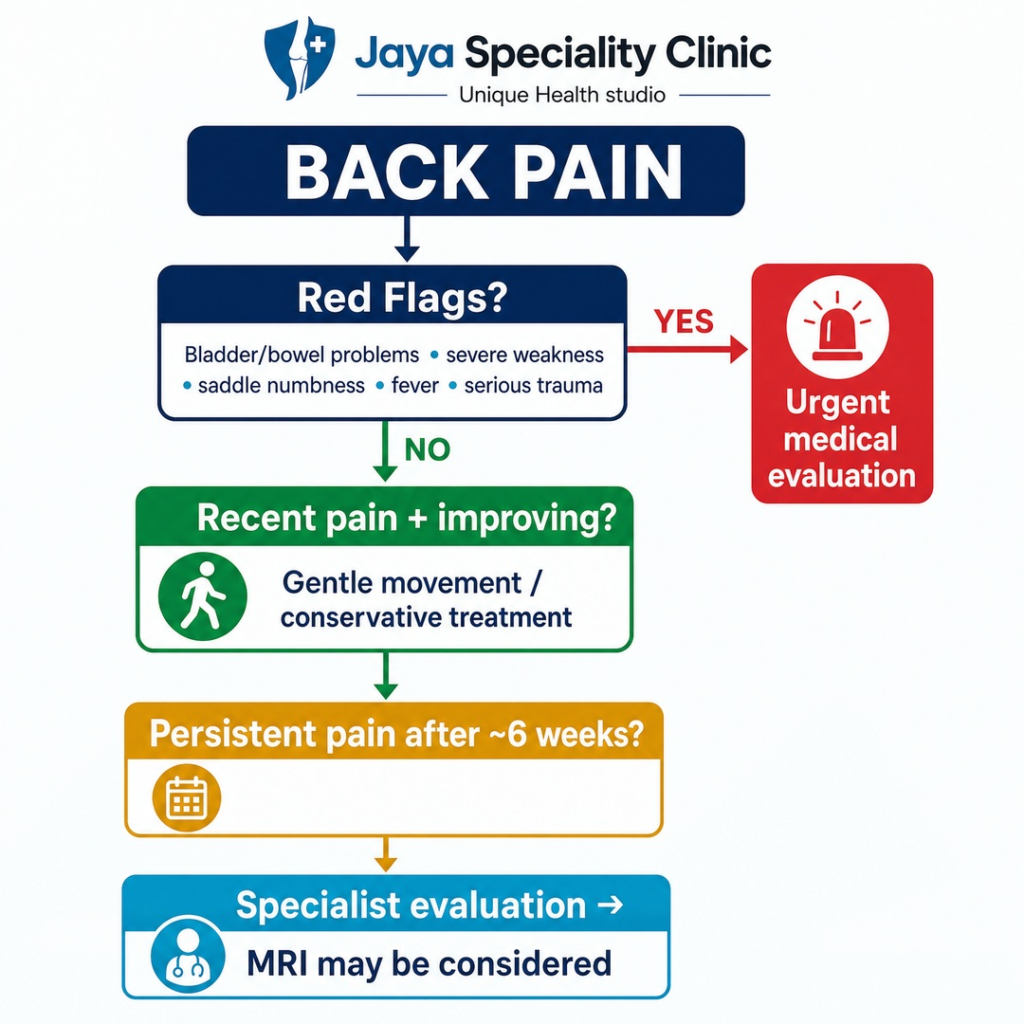
Emergency Symptoms Requiring Immediate MRI
| Red Flag Symptom | What It Might Mean |
| Loss of bladder or bowel control | Cauda equina syndrome (spinal emergency) |
| Severe or worsening leg weakness | Nerve compression requiring urgent surgery |
| Numbness in groin or saddle area | Cauda equina syndrome |
| Fever combined with back pain | Spinal infection (discitis, osteomyelitis) |
| History of cancer + new back pain | Possible spinal metastasis |
| Unexplained weight loss + back pain | Possible tumor or infection |
| Recent serious trauma or fall | Spinal fracture |
| IV drug use + back pain | Spinal infection risk |
If you have any of these symptoms, get an MRI within 24-48 hours. Delaying can lead to permanent nerve damage.
When You Should Wait Before Getting an MRI
For most people with back pain, the answer is simple: wait at least 6 weeks.
Research shows that acute back pain (less than 6 weeks) is usually self-limiting. Your body heals on its own with rest and gentle movement. Getting an MRI too early often reveals findings unrelated to your current pain.
The 6-Week Rule
Wait and try conservative treatment first if:
•Your pain started recently (less than 6 weeks ago)
•You have no red flag symptoms
•The pain improves with rest and gentle movement
•You can still walk, sit, and do daily activities
Consider an MRI after 6 weeks if:
•Conservative treatment (physiotherapy, medication) has not helped
•Pain is getting worse instead of better
•Pain is radiating down your leg (sciatica) and not improving
•Your doctor suspects a specific structural problem
MRI Cost in Chennai: What to Expect
One of the most common concerns is the cost. In Chennai, a lumbar spine MRI typically costs between Rs. 3,500 and Rs. 8,000, depending on the facility and whether contrast dye is used.
| MRI Type | Approximate Cost in Chennai |
| Lumbar spine MRI (without contrast) | Rs. 3,500 – 5,000 |
| Lumbar spine MRI (with contrast) | Rs. 5,000 – 8,000 |
| Full spine MRI | Rs. 8,000 – 12,000 |
| MRI at premium hospitals | Rs. 8,000 – 18,000 |
Many patients in West Mambalam and T. Nagar visit Jaya Speciality Clinic for a proper consultation before spending money on imaging.
Can Back Pain Be Diagnosed Without an MRI?
Yes, in most cases. An experienced doctor can diagnose the cause of back pain through:
1.Physical examination — testing range of motion and reflexes
2.Medical history — understanding when pain started
3.Neurological testing — checking for nerve involvement
4.X-ray — ruling out fractures
At Jaya Speciality Clinic in West Mambalam, doctors follow a conservative-first approach. They assess your condition thoroughly before recommending any imaging.
What to Do Instead of Rushing to Get an MRI
If your back pain is not an emergency, here is a smarter approach:
Week 1-2: Rest, ice or heat, and prescribed pain medication.
Week 3-4: Start gentle physiotherapy. Many patients improve significantly.
Week 5-6: If pain persists, consult a specialist for targeted treatment.
After Week 6: If treatment has failed, an MRI becomes justified.
Non-Surgical Treatment Options in Chennai
If your MRI shows a disc problem or nerve compression, surgery is NOT always the answer. Many patients in Chennai are successfully treated with non-surgical methods:
1. Physiotherapy and Rehabilitation
The first line of treatment for most back pain. Targeted exercises strengthen the muscles supporting your spine and reduce pressure on nerves.
2. PRP (Platelet-Rich Plasma) Therapy
Your own blood is processed to concentrate healing factors, then injected into the affected area. PRP therapy stimulates natural tissue repair without surgery.
3. Radiofrequency Ablation (RFA)
For chronic back pain caused by nerve irritation, RFA uses heat to block pain signals from specific nerves. Results can last 6-12 months.
4. Epidural Steroid Injections
Anti-inflammatory medication is delivered directly to the affected nerve root, providing rapid pain relief and reducing the need for surgery.
At Jaya Speciality Clinic, the team specializes in Back Pain & Spine Treatment in Chennai using these advanced non-surgical techniques.
FAQ: When Should You Get an MRI for Back Pain?
You should get an MRI for back pain when: (a) you have emergency red flag symptoms like loss of bladder control or severe leg weakness, or (b) your pain has not improved after 6 weeks of conservative treatment (physiotherapy, medication, rest). For most people without these conditions, an MRI is not necessary.
No. In most cases, you should see a doctor first. A physical examination and medical history allow the doctor to determine whether an MRI is actually needed. Getting an MRI without a doctor’s guidance often leads to unnecessary scans and confusing results.
In India, a lumbar spine MRI costs between Rs. 3,000 and Rs. 18,000. In Chennai, the average cost is Rs. 3,500 to Rs. 8,000 depending on the facility. Premium hospitals charge more, while diagnostic centers offer lower rates.
Yes. An experienced orthopedic doctor can diagnose most back pain through physical examination, medical history, and neurological testing. X-rays can rule out fractures. An MRI is only needed when the doctor suspects a specific soft tissue problem like disc herniation or nerve compression that cannot be confirmed through examination alone.
An MRI shows soft tissues that X-rays cannot see: spinal discs (herniation, bulging), spinal nerves (compression, inflammation), the spinal cord itself, ligaments, and soft tissue masses like tumors or infections. X-rays only show bone structure and alignment.
About Jaya Speciality Clinic
Jaya Speciality Clinic is a trusted orthopedic clinic in West Mambalam, Chennai, offering comprehensive care for back pain, spine disorders, sciatica, disc-related conditions, and other musculoskeletal problems. Led by Dr. Balachandar M, Senior Orthopaedic Surgeon, the clinic follows a careful, patient-focused approach—evaluating symptoms and performing a clinical assessment before recommending investigations such as an MRI. When appropriate, patients can also receive non-surgical back and spine treatments, including physiotherapy, rehabilitation, and other targeted treatment options based on their condition.
Conclusion
An MRI for back pain is a powerful diagnostic tool — but it is not needed for everyone. If you have emergency symptoms, get one immediately. If your pain is chronic and not improving after 6 weeks of treatment, an MRI can help your doctor create a precise treatment plan. But for most people with recent-onset back pain, conservative treatment works better than rushing to get scanned.
The key is to consult a qualified specialist who can evaluate your situation and recommend the right next step.