
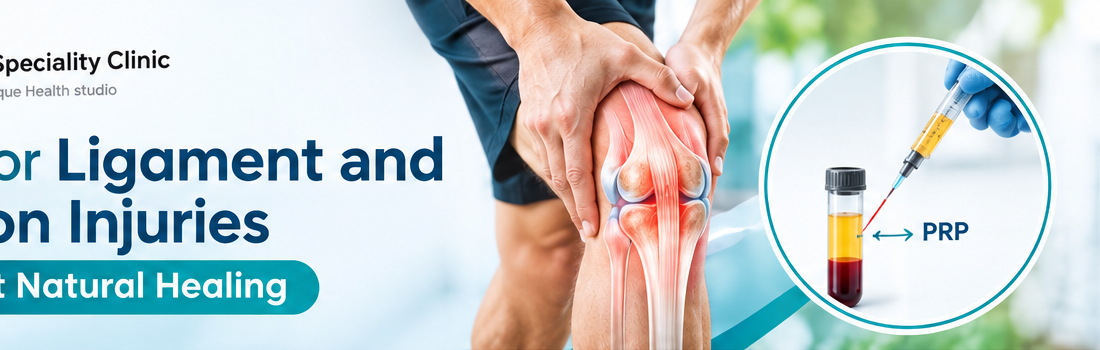
Ligament and tendon injuries can be frustrating because pain often continues even after the initial injury seems to have settled. A sudden sports movement, repetitive activity, awkward fall, or overuse can damage these tissues and affect everyday activities. If you are looking for PRP for Ligament and Tendon Injuries, it is important to understand how the treatment works, who may benefit, and what recovery involves.
Tendons connect muscles to bones, while ligaments connect bones and help stabilize joints. Unlike some other tissues, they generally have a limited blood supply, which can contribute to slower healing. Persistent pain, swelling, weakness, stiffness, and difficulty returning to sports or normal activities may occur when an injury does not heal properly. This is why simply resting the affected area may not always be enough.
What Are Ligament and Tendon Injuries?
Ligament and tendon problems can occur suddenly or develop gradually.
Ligament injuries commonly happen when a joint is twisted, overstretched, or subjected to sudden force. Knee and ankle ligament injuries are particularly common among people involved in sports.
Tendon injuries may develop from repetitive loading, overuse, poor movement mechanics, or sudden trauma. Common examples include tennis elbow, Achilles tendon problems, rotator cuff tendinopathy, and patellar tendon injuries.
Depending on the injury, symptoms may include:
- Localized pain
- Tenderness around the affected tissue
- Swelling
- Reduced strength
- Stiffness
- Pain during movement
- Difficulty participating in sports or exercise
The correct treatment depends on the type, location, and severity of the injury.
Why Do Some Ligament and Tendon Injuries Take Time to Heal?
One reason is the relatively limited blood supply in many tendons and ligaments. These tissues can also be exposed to repeated stress during everyday movement.
For example, continuing to play sports while a tendon is irritated may repeatedly overload the injured tissue. Similarly, returning to activity too quickly after a ligament injury can interfere with rehabilitation.
A proper assessment helps determine whether the problem is a mild strain, partial tear, chronic tendinopathy, or a more significant injury requiring a different treatment approach.
How Can PRP Help Ligament and Tendon Injuries?
Platelet-Rich Plasma (PRP) is a treatment that uses a concentrated portion of the patient’s own blood.
A small blood sample is collected and processed to concentrate platelets. The resulting PRP is then injected into the targeted area under appropriate medical guidance.
Platelets contain biological substances involved in tissue repair and healing processes. The goal of PRP treatment is to create a supportive environment for the body’s natural healing response.
However, PRP is not a guaranteed cure and is not suitable for every ligament or tendon injury. A specialist should evaluate the injury before recommending it.
Step-by-Step: How PRP Treatment Addresses the Problem
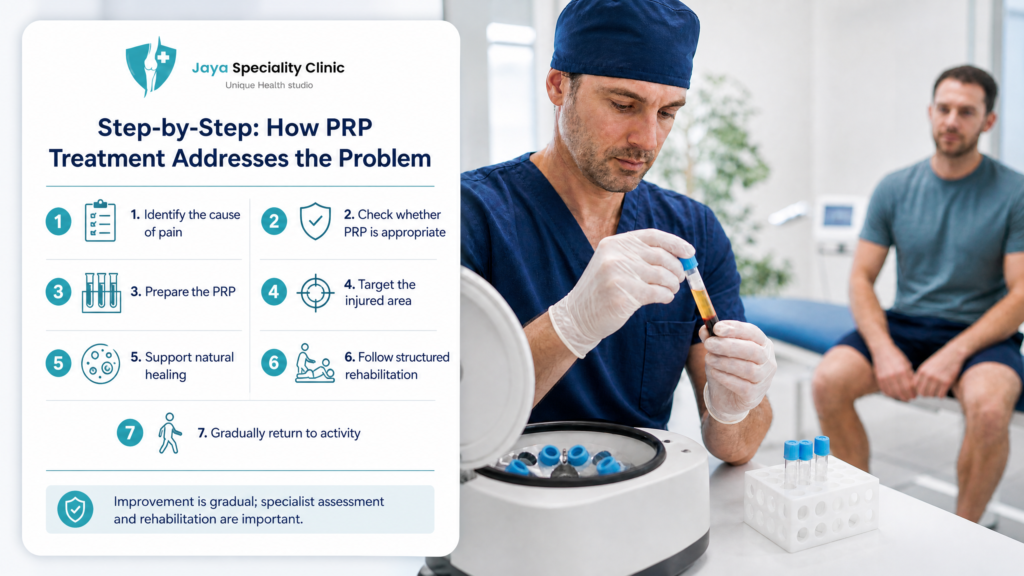
Step 1: Identify the Actual Cause of Pain
The first step is not the injection. It is finding out what is causing the symptoms.
An orthopedic specialist may assess:
- Where the pain occurs
- How the injury happened
- Movement and joint stability
- Muscle strength
- Tenderness
- Functional limitations
Imaging such as ultrasound or MRI may be recommended when necessary to understand the extent of tendon or ligament damage.
Step 2: Determine Whether PRP Is Appropriate
Once the injury has been assessed, the doctor determines whether PRP is a reasonable option.
PRP may be considered for selected chronic tendon problems and certain partial ligament or tendon injuries. The decision depends on the tissue involved, severity of damage, duration of symptoms, previous treatment, and individual recovery goals.
A complete ligament rupture requiring mechanical stabilization may need a different treatment strategy.
Step 3: Prepare the PRP
A small quantity of the patient’s blood is collected.
The blood is processed using a specialized preparation method to separate and concentrate the platelets from other blood components.
This creates the PRP preparation that will be used for the injection.
Step 4: Target the Injured Area
The PRP is carefully delivered to the affected tissue.
Depending on the injury and clinical setup, imaging guidance such as ultrasound may be used to help accurately target the area.
This is particularly useful when the injured tendon or ligament is located deep within the body or close to important structures.
Step 5: Support the Healing Process
Following the injection, the aim is to support the body’s natural repair process.
PRP does not immediately rebuild a damaged tendon or ligament. Instead, it is intended to support biological healing mechanisms over time.
Patients should understand that improvement is generally gradual rather than immediate.
Step 6: Follow a Structured Rehabilitation Program
PRP should not be viewed as a standalone solution.
Rehabilitation is an important part of recovery. Depending on the injury, a physiotherapist may introduce:
- Gentle range-of-motion exercises
- Progressive strengthening
- Muscle control exercises
- Balance training
- Stretching
- Sport-specific rehabilitation
The exercises are gradually progressed according to the patient’s symptoms and recovery.
Step 7: Gradually Return to Activity
Returning to sports or heavy physical activity too soon can place unnecessary stress on healing tissue.
A gradual return allows strength, flexibility, balance, and movement control to improve before higher loads are introduced.
For athletes, the final stage may include sport-specific movements and progressive loading under professional guidance.
Which Injuries May Be Considered for PRP?
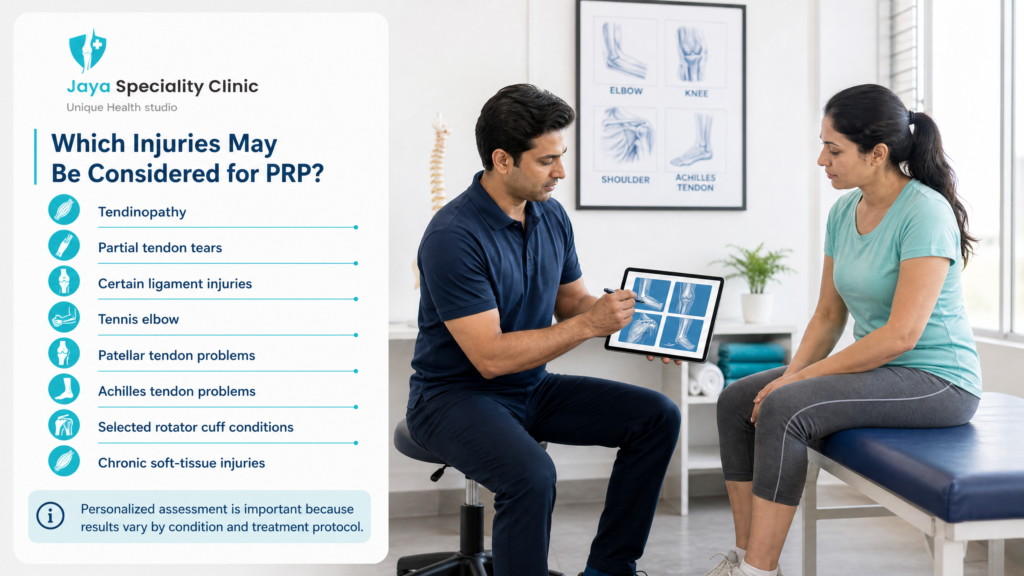
PRP may be considered in selected cases of:
- Tendinopathy
- Partial tendon tears
- Certain ligament injuries
- Tennis elbow
- Patellar tendon problems
- Achilles tendon problems
- Selected rotator cuff conditions
- Chronic soft-tissue injuries
Not every injury responds in the same way. The evidence for PRP also varies depending on the specific condition and treatment protocol.
That is why personalized assessment is important before choosing PRP.
What Can You Expect After PRP Treatment?
Some patients experience temporary soreness or discomfort around the injection site. This can happen as the body responds to the treatment.
Recovery varies according to the location and severity of the injury. Your doctor may recommend modifying activities for a period and then beginning or continuing a rehabilitation program.
It is important to follow the post-treatment instructions provided by your healthcare professional rather than returning immediately to intense exercise.
Is PRP Better Than Surgery?
PRP and surgery are not direct alternatives in every situation.
For selected partial injuries or chronic tendon problems, PRP may be considered as part of a non-surgical treatment plan. However, a complete ligament rupture, major structural damage, or persistent joint instability may require surgical evaluation.
The appropriate approach depends on the injury, symptoms, physical examination, imaging findings, and the patient’s activity goals.
When Should You See an Orthopedic Specialist?
Do not ignore persistent pain after an injury. Professional evaluation is particularly important if you experience:
- Severe pain after an accident or sports injury
- Significant swelling
- Joint instability
- Sudden loss of strength
- Difficulty walking or using the affected limb
- Persistent pain despite rest
- Repeated injuries in the same area
- Difficulty returning to normal activities
Early assessment can help identify the problem and prevent inappropriate treatment.
Frequently Asked Questions
PRP may support the healing process in selected ligament injuries, particularly some partial injuries. However, it cannot be expected to reconnect every completely torn ligament. The injury should be evaluated before treatment.
PRP may be considered for certain chronic tendon conditions and partial tendon injuries. Results can vary depending on the tendon involved, severity, duration of symptoms, and rehabilitation program.
PRP is not designed to provide instant pain relief. Improvement, when it occurs, may develop gradually over weeks as the tissue undergoes healing and rehabilitation.
You may need to temporarily modify your activities after treatment. The timing of exercise depends on the injured tissue and your individual recovery. A doctor or physiotherapist can guide your progression.
Because PRP is prepared from the patient’s own blood, it avoids some concerns associated with donor-derived products. However, like any injection, PRP can have risks and is not appropriate for everyone. Proper medical assessment is important.
PRP and physiotherapy serve different purposes. PRP may be used to support healing in selected cases, while physiotherapy helps restore strength, movement, and function. They may be combined when clinically appropriate.
About Jaya Speciality Clinic
Jaya Speciality Clinic is a trusted Orthopedic Clinic in West Mambalam, Chennai, providing personalized care for ligament injuries, tendon problems, sports injuries, joint pain, and other musculoskeletal conditions. Led by Dr. Balachandar M, Senior Orthopaedic Surgeon, the clinic focuses on identifying the underlying cause of pain before recommending treatment.
Depending on the condition, treatment may include activity modification, physiotherapy and rehabilitation, injections, PRP therapy, and other appropriate non-surgical options. When PRP is considered, the treatment plan is tailored to the patient’s injury, symptoms, imaging findings, and recovery goals.
For patients looking for PRP for Ligament and Tendon Injuries in Chennai, Jaya Speciality Clinic provides specialist evaluation to determine whether PRP is appropriate for their particular condition.
Conclusion
Ligament and tendon injuries can take time to recover, particularly when the tissue is repeatedly stressed or the injury has become chronic. PRP for Ligament and Tendon Injuries may be a useful treatment option for selected patients when combined with proper diagnosis and rehabilitation.
PRP is not suitable for every injury, and it should not be considered a replacement for surgery when major structural damage requires surgical treatment. The best approach is to identify the cause of the injury, assess its severity, choose an appropriate treatment, and follow a structured recovery plan.