

An ACL injury can happen suddenly during sports, running, jumping, or a quick change in direction. You may hear a popping sound, feel sudden knee pain, or notice swelling soon after the injury. The knee may also feel unstable or give way while walking. Early evaluation and the right treatment plan can help you start recovery safely.
The fastest way to recover from an ACL injury is not simply to rest and return to activity quickly. Recovery depends on the type of tear, knee stability, swelling, movement, activity level, and whether other structures such as the meniscus or cartilage are injured. Some ACL injuries can be managed without surgery, while others may require ACL reconstruction. The treatment decision should be made after a proper examination.
What Is an ACL Injury?
The anterior cruciate ligament, commonly called the ACL, is one of the main ligaments inside the knee. It helps control forward movement and stability of the knee.
An ACL tear can be partial or complete. It commonly occurs when the knee suddenly twists, the body changes direction quickly, or a person lands awkwardly after a jump. Sports such as football, basketball, cricket, badminton, and other activities involving running and sudden movements can place stress on the ACL.
Common symptoms include:
- Sudden knee pain.
- A popping feeling or sound.
- Knee swelling.
- Difficulty putting weight on the leg.
- Reduced knee movement.
- A feeling that the knee may give way.
- Difficulty returning to sports.
If you experience these symptoms after a knee injury, an orthopaedic evaluation is important.
What Is the Fastest Way to Recover from an ACL Injury?
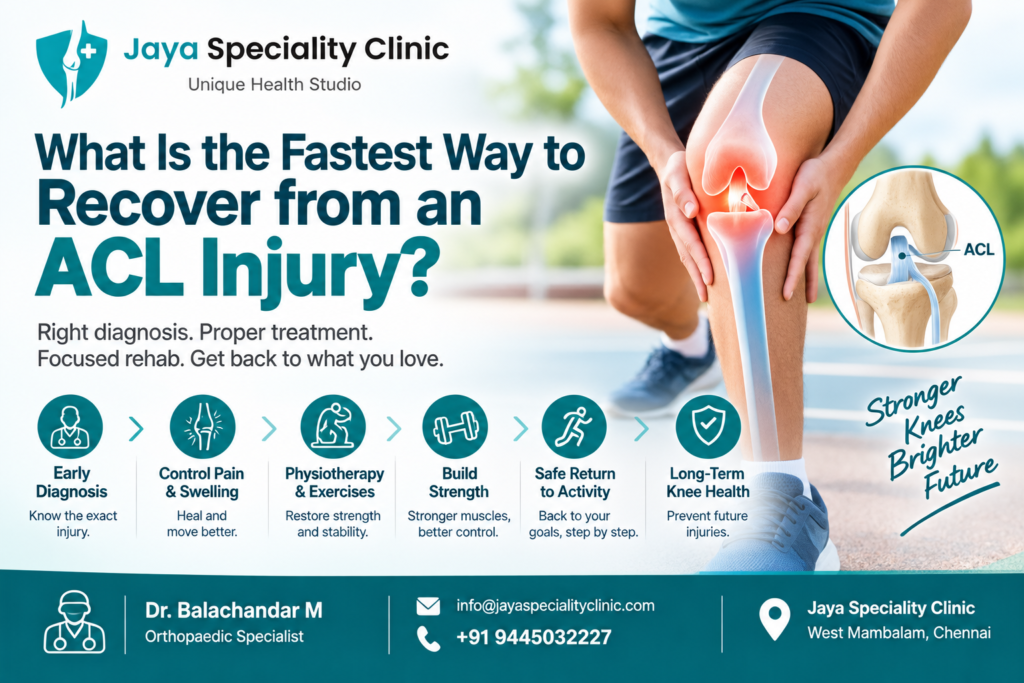
There is no single ACL recovery method that works for everyone. A safe and structured plan is usually the quickest path to regaining movement and strength without rushing the healing process.
Here is a simple step-by-step approach.
Step 1: Get the Knee Evaluated Early
The first step in ACL injury recovery is finding out exactly what has happened.
Your doctor may ask how the injury occurred and whether you experienced swelling, pain, instability, or a popping sensation.
A physical examination can assess knee movement, stability, strength, and other signs of ligament injury. MRI may be used to confirm an ACL injury and check for associated meniscus, cartilage, or other ligament damage.
Early diagnosis helps create the right treatment plan.
Step 2: Control Pain and Swelling
Swelling can make it difficult to move the knee normally.
During the early stage, your doctor may recommend appropriate measures to control pain and swelling. Depending on the injury, temporary support, reduced weight-bearing, or crutches may be advised.
Do not force the knee through severe pain.
The goal is to protect the injured knee while gradually preparing it for rehabilitation.
Step 3: Restore Knee Movement
Getting normal knee movement back is an important part of ACL rehabilitation.
After the initial injury, the knee may become stiff because of swelling and pain. Your physiotherapist may introduce gentle movements to improve flexibility and range of motion.
The exercises should be selected according to your injury.
Trying advanced exercises too early can place unnecessary stress on the knee. A gradual approach is safer.
Step 4: Start ACL Physiotherapy
ACL physiotherapy plays an important role in recovery.
A physiotherapy programme may focus on:
- Restoring knee movement.
- Reducing stiffness.
- Improving muscle strength.
- Improving balance.
- Building leg control.
- Improving walking.
- Preparing the knee for daily activities or sports.
The programme changes as the knee becomes stronger.
Good rehabilitation is not about doing the most exercises. It is about doing the right exercises at the right stage.
Step 5: Strengthen the Muscles Around the Knee
After an ACL injury, the muscles around the knee can become weaker.
The quadriceps, hamstrings, hips, and calf muscles all contribute to lower-limb control. Your physiotherapist may gradually introduce ACL strengthening exercises based on your recovery.
Common types of exercises may include:
- Straight-leg exercises.
- Controlled knee movements.
- Quadriceps strengthening.
- Hamstring strengthening.
- Hip strengthening.
- Balance exercises.
- Controlled step exercises.
These are examples only. Your exact ACL recovery exercises should be selected by a qualified professional according to your condition.
Step 6: Decide Whether Surgery Is Needed
Not every ACL tear needs surgery.
Treatment depends on several factors, including knee stability, activity level, work or sports requirements, associated injuries, and the patient’s individual circumstances. Some lower-risk patients may be managed without reconstruction.
For active people who want to return to sports involving cutting, pivoting, or sudden changes in direction, ACL reconstruction may be considered.
The American Academy of Orthopaedic Surgeons recommends ACL reconstruction rather than repair for many midsubstance ACL tears because reconstruction has a lower revision rate. The decision, however, should be individualised.
Step 7: Follow the ACL Rehabilitation Plan After Surgery
If ACL reconstruction is recommended, ACL reconstruction recovery requires patience.
Rehabilitation usually begins soon after surgery under professional guidance.
The early goals may include:
- Managing swelling.
- Restoring knee movement.
- Activating the thigh muscles.
- Improving walking.
- Gradually increasing strength.
Later stages may focus on strength, balance, coordination, running, jumping, and sport-specific movements.
The exact ACL surgery recovery timeline varies from person to person.
Returning to sports should not be based only on the number of weeks since surgery. Functional assessment can be one factor used when deciding whether a patient is ready to return to sport.
Step 8: Do Not Rush Back to Sports
One of the biggest mistakes during ACL tear recovery is returning to sports too soon.
Feeling less pain does not always mean the knee is ready for demanding activity.
Your knee may need to regain:
- Strength.
- Stability.
- Balance.
- Movement control.
- Confidence.
- Sport-specific ability.
Your doctor or physiotherapist can guide you through each stage.
A gradual return can help you build the physical control needed for your normal activities.
How Long Does ACL Recovery Take?
ACL recovery time varies widely.
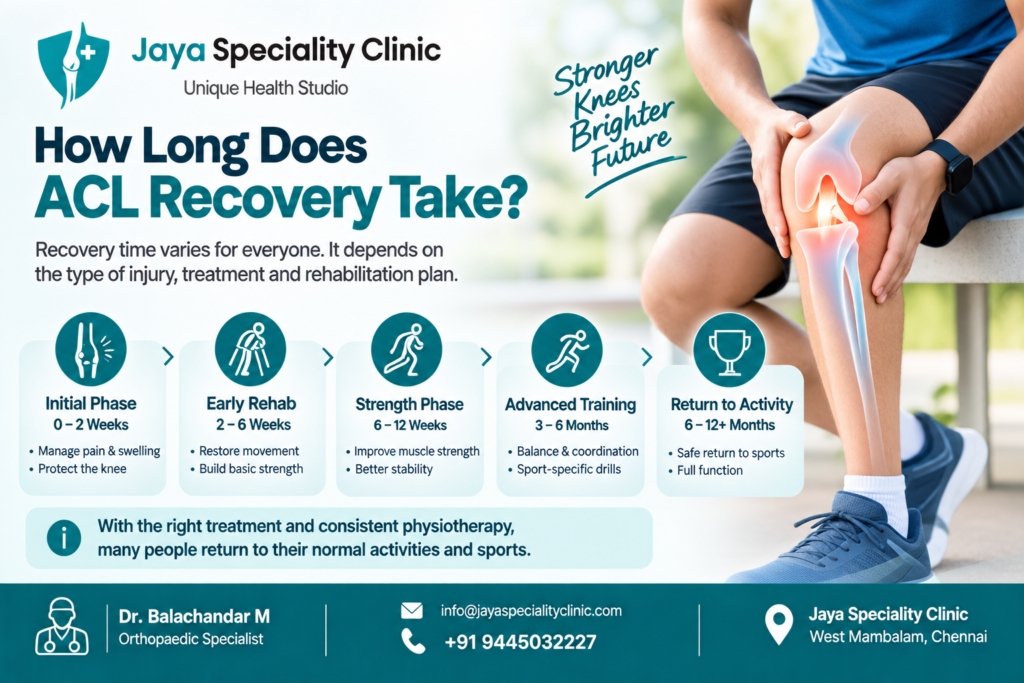
A mild injury managed without surgery may have a different recovery period from a complete tear treated with reconstruction. Recovery can also take longer when the ACL injury occurs with a meniscus or cartilage injury.
After ACL reconstruction, rehabilitation commonly continues for many months. The exact timeline depends on healing, strength, movement, rehabilitation progress, and the demands of the person’s sport or work.
There is no safe shortcut that guarantees fast recovery.
The goal should be safe and complete recovery, not simply the earliest possible return.
ACL Recovery Exercises: What Should You Do?
Exercise is an important part of ACL injury rehabilitation, but the exercises should match the stage of recovery.
Early Stage
The focus may be on gentle movement, swelling control, and muscle activation.
Strength Stage
The focus may move towards quadriceps, hamstring, hip, and calf strengthening.
Balance Stage
Balance and coordination exercises can help improve knee control.
Advanced Stage
For athletes, rehabilitation may eventually include running, jumping, landing, direction changes, and sport-specific drills.
Do not copy an advanced ACL rehabilitation programme from another patient. Your injury may be different.
What Can Slow Down ACL Recovery?
Several factors can affect knee ligament injury recovery.
These may include:
- Returning to sports too early.
- Skipping physiotherapy.
- Poor exercise technique.
- Weak muscles.
- Persistent swelling.
- Limited knee movement.
- Associated meniscus or cartilage injuries.
- Not following medical advice.
- Trying to progress exercises too quickly.
Recovery works best when progress is gradual and monitored.
When Should You See an Orthopaedic Doctor?
You should seek an orthopaedic evaluation after a significant knee injury, especially if you notice:
- A popping sensation.
- Sudden swelling.
- Severe knee pain.
- Difficulty walking.
- Knee instability.
- Repeated episodes of the knee giving way.
- Inability to fully bend or straighten the knee.
Early assessment can help identify the injury and associated problems.
ACL Injury Treatment at Jaya Speciality Clinic
Jaya Speciality Clinic in West Mambalam, Chennai, provides orthopaedic care for sports injuries and ligament problems, including ACL and other knee ligament injuries. The clinic offers evaluation, treatment planning, physiotherapy support, and rehabilitation guidance based on the patient’s condition.
Dr. Balachandar M is listed by the clinic as an Orthopaedic Doctor and Knee Replacement Surgeon. The clinic’s services include sports injury treatment, ACL and ligament injury treatment, and physiotherapy and rehabilitation support.
The treatment approach depends on the severity of the injury, knee stability, activity requirements, and associated injuries. Some patients may be suitable for conservative treatment, while others may require surgical management followed by rehabilitation.
The important point is to understand the injury before choosing treatment.
Simple Tips for Faster ACL Recovery
Remember these simple points:
1. Get diagnosed early.
Know the exact injury.
2. Control swelling.
Follow the treatment advice given by your doctor.
3. Restore movement.
Work gradually on knee flexibility.
4. Build strength.
Follow suitable ACL rehab exercises.
5. Attend physiotherapy.
Stay consistent with your rehabilitation programme.
6. Do not rush.
Avoid returning to sports before you are ready.
7. Follow up regularly.
Your treatment plan may change as your knee improves.
Frequently Asked Questions
The fastest safe approach is early diagnosis followed by a structured treatment and rehabilitation plan. The right approach depends on the type of tear, knee stability, activity level, and associated injuries.
Some ACL injuries can be managed without surgery, particularly in selected patients with lower activity demands and a stable knee. Treatment should be decided after proper evaluation.
ACL recovery time varies. Non-surgical recovery and ACL reconstruction recovery follow different timelines. Associated injuries and rehabilitation progress can also affect recovery.
Yes. ACL physiotherapy can help restore movement, strength, balance, and knee control. A structured rehabilitation programme is an important part of recovery.
Exercises depend on the stage of recovery. They may include movement exercises, quadriceps strengthening, hamstring strengthening, hip strengthening, balance work, and later sport-specific exercises.
Some people can walk after an ACL injury, while others have pain, swelling, or instability. Your doctor can advise you about weight-bearing based on the injury.
No. Surgery is not required for every ACL injury. The decision depends on factors such as knee stability, activity level, associated injuries, and individual goals.
Follow your surgeon’s rehabilitation plan, attend physiotherapy, perform prescribed exercises correctly, and avoid returning to demanding activities too early.
Return to sport depends on recovery, strength, movement control, functional testing, and medical clearance. Time alone should not be the only measure.
Conclusion
The fastest way to recover from an ACL injury is not to rush the recovery process. It is to follow the right steps in the right order.
Start with an accurate diagnosis. Control pain and swelling. Restore knee movement. Begin appropriate ACL physiotherapy. Build strength gradually. If surgery is required, follow a structured ACL reconstruction recovery programme. Finally, return to sports only when your knee has regained the required strength, stability, and control.
Every ACL injury is different. A personalised treatment and rehabilitation plan can help you work towards a safe return to normal activities.
If you have an ACL injury or ongoing knee instability, consult an orthopaedic specialist for an individual assessment.