
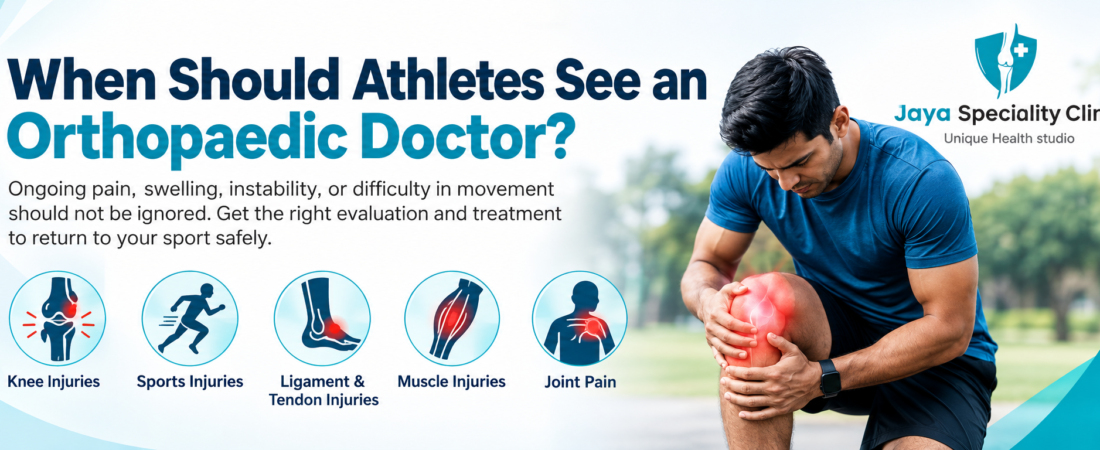
Athletes put their muscles, joints, bones, and ligaments under regular stress. Training, running, jumping, twisting, and sudden changes in direction can sometimes cause injuries. A small injury may improve with rest, but ongoing pain, swelling, weakness, or difficulty moving should not be ignored. Knowing when to see an orthopaedic doctor can help athletes get the right treatment and return to activity safely. An orthopaedic doctor for athletes can evaluate the injury, identify the cause, and suggest an appropriate treatment and rehabilitation plan.
Sports injuries can happen during professional training, school sports, gym workouts, or weekend activities. Common problems include muscle strains, tendon injuries, ligament injuries, joint pain, and knee injuries in athletes. Some injuries may be minor, while others, such as an ACL tear or serious meniscus injury, may need detailed evaluation. ACL injuries can cause swelling, instability, difficulty bearing weight, and reduced knee movement, and medical evaluation is recommended when these symptoms occur.
Quick Signs That an Athlete May Need a Doctor
Look out for these warning signs:
- Severe or increasing pain
- Sudden swelling
- A popping sound during injury
- Joint instability or “giving way”
- Difficulty walking or putting weight on the limb
- Reduced movement
- Pain that does not improve with rest
- Repeated sports injuries
- Weakness after an injury
- Pain that keeps returning during training
These signs do not always mean surgery is needed. They indicate that the injury deserves proper assessment.
Why Should Athletes Take Injuries Seriously?
Many athletes try to “play through the pain.” This may sometimes make an injury worse or delay recovery.
For example, an athlete with sports-related knee pain may continue training because the pain feels manageable. However, if the knee repeatedly swells or gives way, there may be an underlying ligament, meniscus, cartilage, or other joint problem.
The goal of sports injury treatment is not simply to reduce pain. The doctor also looks at movement, strength, stability, and the athlete’s activity requirements.
Step-by-Step: What Should an Athlete Do After an Injury?
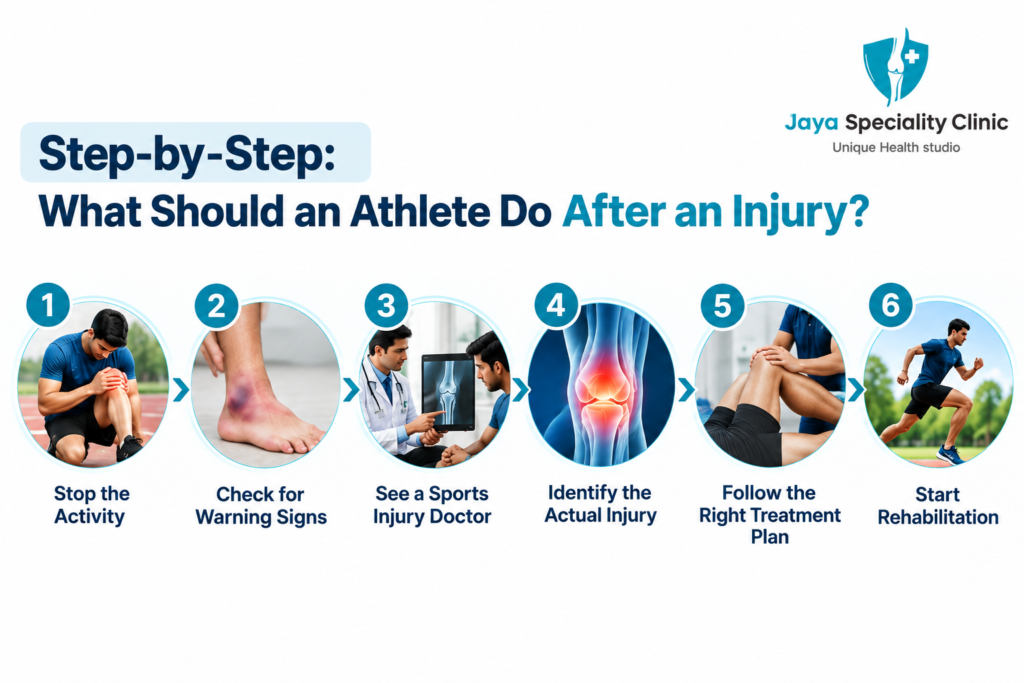
Step 1: Stop the Activity
The first step is to stop the activity that caused the pain.
Continuing to run, jump, lift, or play through significant pain can place additional stress on the injured area. Give the body time to settle before returning to training.
Step 2: Check for Warning Signs
Look at the symptoms carefully.
Ask:
- Is there swelling?
- Can you walk normally?
- Can you move the joint?
- Did you hear a pop?
- Does the joint feel unstable?
- Is the pain getting worse?
- Did the injury happen after a twist, fall, or direct impact?
These simple observations can help determine whether medical evaluation is needed.
Step 3: See a Sports Injury Doctor When Symptoms Continue
If pain continues despite rest or keeps returning during exercise, consider seeing a sports injury doctor.
An orthopaedic doctor for sports injuries can assess the affected bone, joint, muscle, tendon, or ligament. Depending on the symptoms, the doctor may recommend imaging such as an X-ray or MRI.
For example, an MRI may help confirm an ACL injury and identify associated problems involving the meniscus, cartilage, or other ligaments.
Step 4: Identify the Actual Injury
Not every sports injury is the same.
Some common sports injuries include:
Muscle Injuries
Muscle strains can occur when a muscle is stretched beyond its normal limit. They may cause pain, tenderness, and weakness.
Tendon Injuries
Repeated training can place stress on tendons. Tendon injuries in athletes may cause pain during movement or exercise.
Ligament Injuries
Ligaments connect bones and help stabilize joints. A sudden twist, landing, or change of direction can cause ligament injuries.
Knee Injuries
The knee experiences significant stress during running, jumping, cutting, and landing. Knee injuries in athletes can involve ligaments, menisci, cartilage, muscles, or tendons.
Step 5: Follow the Right Treatment Plan
The correct treatment for sports injuries depends on the type and severity of the problem.
Treatment may include:
- Activity modification
- Pain and swelling management
- Physiotherapy
- Strengthening exercises
- Mobility exercises
- Balance training
- Bracing when appropriate
- Other non-surgical treatments
- Surgery when clinically necessary
Treatment should be based on the actual diagnosis rather than simply treating the pain.
Jaya Speciality Clinic follows a conservative-first approach, with treatment planned according to the patient’s condition and needs.
Step 6: Start Sports Injury Rehabilitation
Recovery does not end when pain becomes better.
Sports injury rehabilitation helps an athlete gradually restore strength, flexibility, balance, coordination, and movement.
Physiotherapy for sports injuries may be used as part of recovery. Exercises can be progressed gradually depending on the injury and the athlete’s recovery.
For athletes recovering from an ACL injury, rehabilitation can involve restoring knee movement, improving muscle strength, and developing stability and control before returning to sport.
Step 7: Return to Sport Slowly
One common mistake is returning to sport too soon.
Feeling less pain does not always mean the injury is completely recovered. An athlete may need to regain strength, movement, balance, and joint stability before returning to full activity.
A gradual return can reduce unnecessary stress on the injured area.
The return-to-sport plan should be based on the injury, treatment, physical condition, and sport-specific demands.
When Do Athletes Need ACL Injury Treatment?
The ACL is an important ligament that helps stabilize the knee. ACL injuries are common in sports involving sudden stopping, twisting, cutting, or incorrect landing.
Athletes should seek medical evaluation if they experience:
- A sudden popping sensation
- Rapid knee swelling
- Knee instability
- Difficulty bearing weight
- Loss of knee movement
- Repeated episodes of the knee giving way
ACL injury treatment depends on factors such as knee stability, activity level, associated injuries, and individual treatment needs. Some injuries may be managed without surgery, while active athletes with certain ACL injuries may require reconstruction.
What About Meniscus Injuries?
The meniscus works as a shock absorber inside the knee. A sudden twist or sports movement can cause a meniscus tear.
A meniscus injury may cause:
- Knee pain
- Swelling
- Clicking
- Reduced movement
- Difficulty with sports
- Locking or catching sensations
Meniscus injury treatment depends on the type of tear, symptoms, knee function, and other factors. Some meniscus injuries can be managed without surgery, while certain symptomatic tears may require surgical treatment.
How Can Athletes Prevent Sports Injuries?

Injury prevention for athletes should become part of regular training.
Warm Up Properly
Spend time preparing the muscles and joints before intense activity.
Build Strength
Strong muscles can help support joints during movement.
Improve Balance and Control
Balance exercises can help athletes develop better movement control.
Increase Training Gradually
Avoid suddenly increasing training volume or intensity.
Use Proper Technique
Correct running, jumping, lifting, and landing techniques are important.
Rest When Needed
Recovery is part of training. Persistent pain should not be ignored.
Use the Right Equipment
Appropriate footwear and protective equipment can support safe participation.
When Should Athletes See an Orthopaedic Doctor?
Consider an orthopaedic evaluation when:
Pain persists: Pain continues even after rest.
Swelling appears: A joint becomes noticeably swollen after activity or injury.
The joint feels unstable: The knee, ankle, shoulder, or other joint feels like it may give way.
Movement is restricted: You cannot fully bend or straighten the joint.
There is a popping sound: A sudden pop occurs with pain or swelling.
You cannot bear weight: Walking becomes difficult after an injury.
The injury keeps returning: Repeated pain may indicate an unresolved problem.
Performance changes: Weakness or reduced movement affects your normal sporting activity.
How Can a Sports Injury Specialist Help?
A sports injury specialist focuses on injuries affecting athletes and active people.
The assessment may include:
- Understanding how the injury happened.
- Checking pain and swelling.
- Testing joint movement.
- Checking strength and stability.
- Reviewing sporting activities.
- Ordering imaging when needed.
- Creating a treatment plan.
- Planning rehabilitation and return to activity.
This step-by-step approach helps identify the actual problem instead of simply treating symptoms.
About Jaya Speciality Clinic
Jaya Speciality Clinic provides orthopaedic care for joint, bone, spine, and sports-related problems. The clinic offers sports injury treatment, ACL and ligament injury care, physiotherapy and rehabilitation guidance, and other orthopaedic services.
Dr Balachandar M, MBBS, MS (Orthopaedics), FIAA (Netherlands), FASM (Italy), FIJR, is listed by the clinic as Associate Consultant – Apollo Hospitals, Greams Road. His clinical areas include sports injuries, arthroscopy, ligament injuries, knee problems, and other orthopaedic conditions.
Frequently Asked Questions
An athlete should consider medical evaluation for persistent pain, swelling, instability, restricted movement, repeated injuries, or difficulty walking or playing normally.
Yes, especially if the pain continues, keeps returning, causes swelling, or affects walking, running, or sports performance.
Common problems include muscle strains, tendon injuries, ligament injuries, knee injuries, meniscus tears, and other joint injuries.
No. Many sports injuries can be managed with appropriate non-surgical treatment and rehabilitation. Surgery is considered when it is clinically appropriate.
Physiotherapy can be an important part of recovery for many sports injuries. The exercises and progression should match the specific injury.
Seek evaluation after symptoms such as a knee pop, swelling, instability, difficulty bearing weight, or reduced knee movement.
Some meniscus injuries can be managed without surgery. The appropriate approach depends on the tear, symptoms, knee function, and individual factors.
Proper warm-up, strength training, good technique, gradual training progression, adequate recovery, and appropriate equipment can support injury prevention.
Final Takeaway
Athletes should not ignore pain that persists, swelling, instability, or reduced movement. Early assessment can help identify the cause and guide the right treatment. Whether the problem is a muscle strain, tendon injury, ligament injury, ACL tear, meniscus problem, or athlete joint pain, getting the right diagnosis is an important first step.
Listen to your body. Treat injuries early. Recover properly. Return to sport safely.