
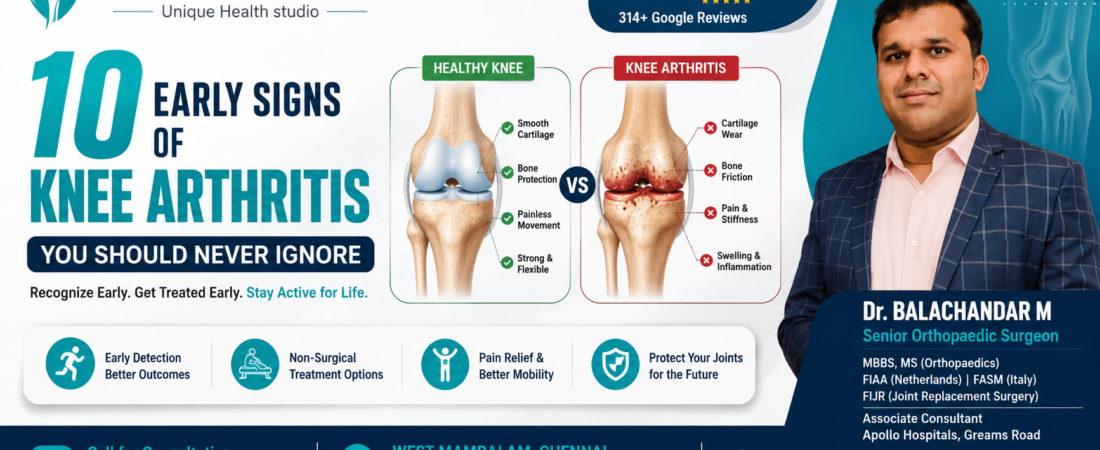
Have you started feeling knee pain while climbing stairs? Do your knees feel stiff when you wake up in the morning? Many people ignore these symptoms, assuming they are simply part of ageing or the result of a busy day. However, these could be the early signs of knee arthritis.
Knee arthritis develops gradually as the protective cartilage inside the knee joint begins to wear down. When diagnosed early, many patients can manage their symptoms with lifestyle changes, physiotherapy, medications, and non-surgical treatment options before the condition becomes severe.
Knee arthritis is one of the leading causes of chronic knee pain among adults over the age of 40. However, younger adults can also develop arthritis due to previous sports injuries, obesity, repetitive stress on the knee, or certain lifestyle factors. Recognizing the warning signs early allows timely treatment, helping reduce pain, maintain mobility, and protect your joints for the future.
What Is Knee Arthritis? Understanding the Early Signs
Knee arthritis is a condition in which the smooth cartilage covering the ends of the knee bones gradually wears away. As this protective layer becomes thinner, the bones no longer move smoothly against each other. This leads to pain, stiffness, swelling, reduced flexibility, and difficulty performing everyday activities.
Although knee arthritis is more common after the age of 40, younger adults may also develop the condition due to previous injuries, excess body weight, repetitive stress, or genetics.
Check Our knee arthritis Treatment in Chennai – https://www.jayaspecialityclinic.com/arthritis-treatment-in-chennai.php
Why Should You Recognize the Early Signs of Knee Arthritis?
Many people wait until the pain becomes unbearable before consulting an orthopedic doctor. Unfortunately, delaying treatment may allow arthritis to progress, making daily activities more challenging.
Early diagnosis offers several benefits, including:
- Better pain management
- Improved joint mobility
- Slower progression of arthritis
- More non-surgical treatment options
- Better quality of life
Seeking medical advice at an early stage may help you manage the condition effectively and delay or even avoid more advanced treatment.
10 Early Signs of Knee Arthritis
Every patient experiences knee arthritis differently, but there are several warning signs that should never be ignored. If you notice one or more of the following symptoms, it is advisable to consult an orthopedic specialist before the condition progresses.
1. Knee Pain While Walking or Climbing Stairs
One of the earliest symptoms is pain while walking, climbing stairs, standing for long periods, or carrying heavy objects. Initially, the discomfort may come and go, but over time it often becomes more frequent and persistent.
2. Morning Stiffness
Do your knees feel stiff when you first get out of bed?
Morning stiffness that improves after a few minutes of movement is one of the most common early signs of knee arthritis. Some people also notice stiffness after sitting for a long time.
3. Swelling Around the Knee
Inflammation inside the joint may cause swelling, making the knee appear puffy or feel warm. Swelling that repeatedly returns should never be ignored, as it may indicate ongoing joint inflammation.
4. Grinding or Clicking Sounds
Hearing a grinding, cracking, or clicking sound while bending your knee may indicate changes in the joint surfaces. These sounds, known as crepitus, are often accompanied by discomfort or stiffness.
5. Difficulty Bending or Straightening the Knee
As arthritis progresses, simple movements such as squatting, kneeling, or fully straightening the leg may become difficult. Reduced flexibility can interfere with work, exercise, and everyday activities.
6. Pain After Physical Activity
Many people notice that knee pain becomes worse after walking long distances, exercising, or participating in sports. Although the discomfort may improve with rest, it often returns during the next activity.
7. Knee Weakness or Feeling Unstable
Some patients describe a sensation that their knee may suddenly “give way” while walking. This instability can affect balance and increase the risk of falls.
8. Difficulty Performing Daily Activities
Simple activities such as climbing stairs, getting up from a chair, sitting on the floor, using Indian-style toilets, or carrying groceries may gradually become uncomfortable as the knee loses strength and flexibility.
9. Changes in the Shape of the Knee
As arthritis progresses, the knee joint may gradually change shape because of bone changes around the joint. Some people notice bowing of the legs or enlarged bony areas near the knee.
10. Recurring Knee Pain
Pain that repeatedly returns over weeks or months should never be ignored. Persistent or recurring discomfort often indicates an underlying joint condition that requires professional evaluation.
When Should You Consult an Orthopedic Doctor?
You should consider consulting an orthopedic specialist if you experience:
- Knee pain lasting more than two weeks
- Daily morning stiffness
- Swelling that keeps returning
- Difficulty climbing stairs
- Pain while walking
- Reduced knee movement
- Knee instability or repeated locking
Early evaluation allows doctors to identify the cause of your symptoms and recommend the most appropriate treatment before the condition worsens.
Can Early Knee Arthritis Be Treated Without Surgery?
Yes. Many patients with early knee arthritis can manage their condition successfully without surgery.
Depending on the severity of arthritis, treatment may include:
- Lifestyle modifications
- Weight management
- Physiotherapy
- Pain-relieving medications
- Activity modification
- PRP (Platelet-Rich Plasma) therapy for selected patients after orthopedic evaluation
The goal of treatment is to reduce pain, improve mobility, and help patients continue their daily activities comfortably. Surgery is generally considered only when conservative treatments no longer provide adequate relief.
Patients experiencing persistent knee pain can also learn more about PRP Treatment in Chennai to understand whether they may be suitable candidates for this advanced non-surgical treatment option.
👉 PRP Treatment in Chennai: https://www.jayaspecialityclinic.com/prp-treatment-in-chennai.php
Frequently Asked Questions
The earliest symptom is often mild knee pain while walking, climbing stairs, or after physical activity, followed by morning stiffness.
Yes. Many patients respond well to physiotherapy, weight management, medications, and selected non-surgical treatments depending on the severity of arthritis.
No. Knee replacement surgery is usually recommended only for advanced arthritis when non-surgical treatments no longer provide sufficient relief.
Patients experiencing persistent knee pain or early signs of knee arthritis can consult an experienced orthopedic specialist at Jaya Speciality Clinic, West Mambalam, Chennai.
Yes. Jaya Speciality Clinic in West Mambalam offers comprehensive evaluation and non-surgical treatment options for suitable patients with early knee arthritis.
About Jaya Speciality Clinic
⭐ 4.9 Stars | 314+ Google Reviews
Jaya Speciality Clinic is a trusted Ortho Clinic in Chennai, Tamil Nadu, providing comprehensive orthopedic care with a patient-first approach. Conveniently located in West Mambalam, the clinic serves patients from T. Nagar, Kodambakkam, Ashok Nagar, Vadapalani, KK Nagar, Saidapet, and surrounding areas.
The clinic offers evidence-based treatment for knee arthritis, sports injuries, PRP therapy, joint pain, arthroscopy, and joint replacement.
Dr. Balachandar M – Senior Orthopaedic Surgeon in Chennai
MBBS, MS (Orthopaedics)
- FIAA (Netherlands)
- FASM (Italy)
- FIJR (Joint Replacement Surgery)
- Associate Consultant – Apollo Hospitals, Greams Road
Every patient is assessed individually before a treatment plan is recommended. Depending on the stage of arthritis, treatment may include lifestyle modification, physiotherapy, PRP therapy, or surgical intervention when clinically appropriate.
Conclusion
Recognizing the early signs of knee arthritis is one of the best ways to protect your knees from long-term damage. Early diagnosis gives you access to more treatment options and may help slow the progression of arthritis while keeping you active.
If you are experiencing persistent knee pain, stiffness, swelling, or difficulty with daily activities, don’t ignore these symptoms. Consulting an experienced orthopedic specialist can help identify the cause and guide you toward the most appropriate treatment—often before surgery becomes necessary.