

A good night’s sleep is essential for maintaining a healthy spine, but persistent back pain can make restful sleep difficult. Many people wake up with stiffness or discomfort without realizing that their sleeping posture may be contributing to the problem. Choosing the best sleeping positions for back pain relief can help reduce pressure on your spine, relax tight muscles, and improve the quality of your sleep. While changing your sleeping position may not cure an underlying spinal condition, it can significantly reduce pain and help you wake up feeling more comfortable. In this guide, you’ll discover the best sleeping positions, learn which habits to avoid, and find practical tips to support a healthier back.
Why Does Sleeping Position Matter?
Your spine naturally forms gentle curves that support your body when you stand, walk, sit, and sleep. During the night, these curves should remain properly aligned. If your sleeping posture twists your spine or places excessive pressure on your lower back, your muscles continue working instead of relaxing. Over time, this may lead to morning stiffness, muscle tightness, neck pain, or worsening lower back pain.
Maintaining good spinal alignment while sleeping allows your muscles and joints to recover overnight, helping you wake up with less discomfort and better mobility.
Best Sleeping Positions for Back Pain Relief
There is no single sleeping position that works for everyone. The ideal posture depends on the cause of your back pain, your body type, and your personal comfort. However, orthopedic specialists commonly recommend the following sleeping positions because they provide better spinal support and reduce unnecessary pressure on the back.
1. Sleeping on Your Back with a Pillow Under Your Knees
Sleeping on your back is often considered one of the best sleeping positions for back pain relief because it keeps your spine in a neutral position and distributes your body weight evenly. Placing a small pillow beneath your knees helps maintain the natural curve of your lower back and reduces stress on the lumbar spine. If you notice a small gap between your lower back and the mattress, placing a rolled towel underneath can provide additional support.
Best for:
- Lower back pain
- Morning stiffness
- General back discomfort
2. Sleeping on Your Side with a Pillow Between Your Knees
Side sleeping is another excellent option, especially if you naturally prefer this position. Placing a pillow between your knees prevents your hips from rotating forward, helping keep your spine properly aligned throughout the night. This simple adjustment reduces pressure on your lower back and can also improve comfort around the hips.
Best for:
- Lower back pain
- Hip discomfort
- Side sleepers
- Mild sciatica symptoms
3. Sleeping in the Fetal Position
The fetal position involves lying on your side with your knees gently drawn toward your chest. This position may help reduce pressure on irritated spinal discs and nerves, making it comfortable for some people with disc-related back pain. Avoid curling up too tightly, as this may place extra stress on your hips and knees. Keeping a pillow between your knees can provide additional support.
Best for:
- Herniated discs
- Certain nerve-related back pain
- People who naturally sleep on their side
4. Sleeping in a Reclined Position
If lying completely flat makes your back pain worse, sleeping in a slightly reclined position may provide better comfort. Elevating your upper body with an adjustable bed or wedge pillow helps reduce pressure on the lower spine while supporting its natural curve. Many people with sciatica, spinal stenosis, or chronic lower back pain find this position easier to maintain throughout the night.
Best for:
- Sciatica
- Spinal stenosis
- Chronic lower back pain
5. Sleeping on Your Stomach – Should You Avoid It?
Sleeping on your stomach is generally the least recommended position for back pain because it flattens the natural curve of your spine and forces your neck to remain turned to one side for several hours. This may lead to neck stiffness, shoulder pain, and increased pressure on the lower back.
If you cannot comfortably sleep in another position, place a thin pillow under your hips or pelvis to reduce strain on your lower back. Using a thin pillow under your head—or none at all—may also help reduce neck stress.
Best for:
- Only if other sleeping positions are uncomfortable
Sleeping Positions for Back Pain Relief – Quick Comparison
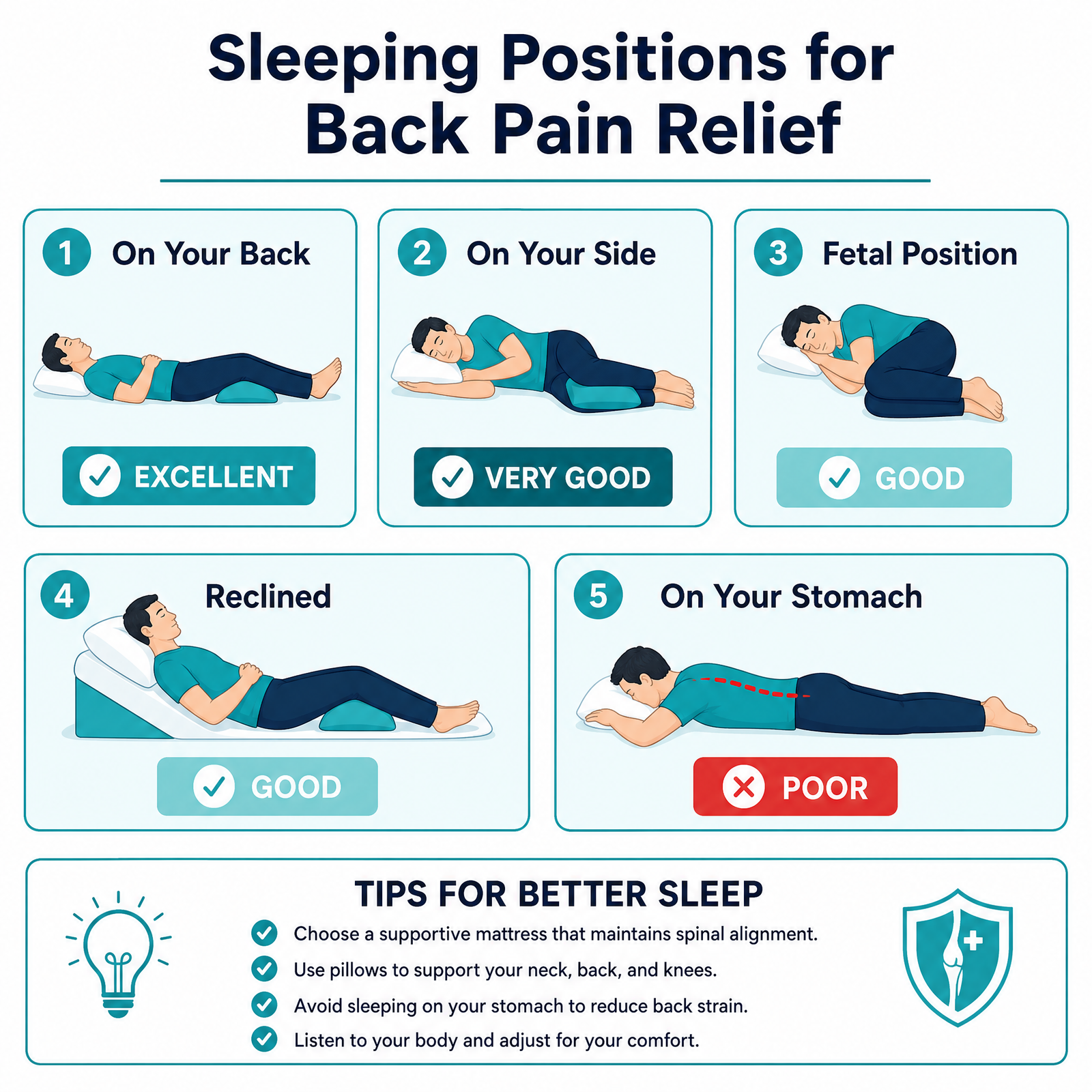
| Sleeping Position | Support Level | Best For |
| Back with a pillow under the knees | ⭐⭐⭐⭐⭐ | General lower back pain, morning stiffness |
| Side with a pillow between the knees | ⭐⭐⭐⭐☆ | Lower back pain, hip pain, side sleepers |
| Fetal position | ⭐⭐⭐⭐☆ | Herniated discs, nerve-related pain |
| Reclined position | ⭐⭐⭐⭐☆ | Sciatica, spinal stenosis |
| Stomach sleeping | ⭐⭐☆☆☆ | Only if no other position is comfortable |
Choosing the Right Mattress and Pillow
The best sleeping positions for back pain relief become even more effective when combined with the right mattress and pillow. A medium-firm mattress is often recommended because it supports your spine while cushioning pressure points. If your mattress is too soft, your hips may sink, placing extra strain on your lower back.
Choose your pillow based on your sleeping posture:
- Back sleepers: Use a medium-height pillow to support your neck.
- Side sleepers: Choose a firm pillow that fills the gap between your shoulder and neck.
- Stomach sleepers: Use a thin pillow—or no pillow—to reduce neck strain.
If your mattress is sagging or more than 7–10 years old, replacing it may improve both your sleep quality and spinal comfort.
When Should You Consult an Orthopedic Doctor?
When Should You Consult an Orthopedic Doctor?
Changing your sleeping position can reduce mild back discomfort, but persistent pain may indicate an underlying orthopedic condition that requires medical attention. If your symptoms continue despite improving your sleeping posture, consider consulting a specialist for a comprehensive evaluation and Back Pain & Spine Treatment in Chennai to identify the underlying cause and receive appropriate care.
Consult an orthopedic specialist if you experience:
- Back pain lasting more than two weeks
- Pain that wakes you during the night
- Pain spreading to your hips or legs
- Numbness or tingling in your legs
- Difficulty walking or standing comfortably
- Back pain after a fall or injury
Early diagnosis can help prevent the condition from worsening and allows your doctor to recommend the most appropriate treatment for faster pain relief and improved mobility.
Frequently Asked Questions
For most people, sleeping on the back with a pillow under the knees is considered one of the best sleeping positions for back pain relief. If you’re a side sleeper, placing a pillow between your knees helps keep your hips and spine aligned, reducing pressure on your lower back.
Yes. Poor sleeping posture can place unnecessary stress on your spine, muscles, and joints. Over time, this may lead to morning stiffness, lower back pain, and poor-quality sleep. Choosing the right sleeping position and using proper pillow support can make a noticeable difference.
A medium-firm mattress is generally recommended because it supports the natural alignment of your spine while cushioning pressure points. The right mattress should keep your back comfortable without allowing your body to sink too deeply.
If you have persistent back pain, stiffness, or difficulty sleeping because of spine-related problems, you can consult Dr. Balachandar M at Jaya Speciality Clinic, West Mambalam, Chennai. The clinic is easily accessible for patients from T. Nagar, Kodambakkam, Ashok Nagar, Vadapalani, KK Nagar, Saidapet, Guindy, and nearby areas.
Yes. Many patients with back pain improve with non-surgical treatments, including physiotherapy, medications, lifestyle modifications, rehabilitation, and other evidence-based orthopedic treatments. The most suitable treatment depends on the underlying cause of your pain.
About Jaya Speciality Clinic
⭐ 4.9 Stars | 314+ Google Reviews
Jaya Speciality Clinic is a trusted Ortho Clinic in Chennai, Tamil Nadu, offering comprehensive orthopedic care with a patient-first approach. Conveniently located in West Mambalam, the clinic serves patients from T. Nagar, Kodambakkam, Ashok Nagar, Vadapalani, KK Nagar, Saidapet, Guindy, and surrounding areas.
The clinic provides advanced diagnosis and treatment for back pain, spine disorders, knee arthritis, sports injuries, PRP therapy, arthroscopy, fracture care, and joint replacement surgery, helping patients regain mobility and improve their quality of life.
Dr. Balachandar M – Senior Orthopaedic Surgeon in Chennai
MBBS, MS (Orthopaedics)
FIAA (Netherlands) | FASM (Italy) | FIJR (Joint Replacement Surgery)
Associate Consultant – Apollo Hospitals, Greams Road
Dr. Balachandar M specializes in both non-surgical and surgical orthopedic treatments. Every patient receives a detailed evaluation before a personalized treatment plan is recommended, ensuring the most appropriate and evidence-based care.
Conclusion
The best sleeping positions for back pain relief can help reduce pressure on your spine, improve sleeping posture, and make your mornings more comfortable. Simple changes, such as sleeping on your back with a pillow under your knees or on your side with a pillow between your legs, can significantly improve spinal alignment and reduce unnecessary strain.
However, if your back pain persists despite improving your sleeping posture, don’t ignore the symptoms. Early diagnosis and appropriate treatment can help prevent the condition from worsening and support a faster recovery.
If you’re experiencing ongoing back pain or spine-related problems, consult Dr. Balachandar M at Jaya Speciality Clinic , West Mambalam, Chennai, for a comprehensive orthopedic evaluation and a personalized treatment plan to help you sleep better, move comfortably, and return to your daily activities with confidence.