

PRP treatment is a simple injection treatment that uses a small amount of your own blood. The blood is processed to concentrate the platelets. The platelet-rich plasma is then injected into the painful or injured area. PRP may be used for some joint, tendon, ligament, and muscle problems.
Many people ask, “Does PRP treatment hurt?” The answer is usually simple. You may feel some discomfort during the injection. You may also have mild pain or soreness after the treatment. The discomfort is usually temporary. Your doctor can explain what you may feel based on the area being treated and your condition.
Does PRP Treatment Hurt?
PRP treatment can cause mild discomfort, but it is generally well tolerated.
A needle is used to draw blood and another needle is used to give the PRP injection. You may feel:
- A small needle prick.
- Mild pressure.
- Short-term discomfort.
- Soreness around the injection area.
- Mild swelling after treatment.
The amount of pain can be different for each person.
Some treatment areas may also be more sensitive than others. Your doctor can discuss pain control and the procedure before treatment.
Is PRP Injection Painful?
A PRP injection can cause some pain or discomfort because it involves a needle. Some clinics may use a local numbing method to reduce discomfort during the injection.
The injection itself is usually quick.
You may feel a brief sting when the needle enters the skin. You may also feel pressure as the PRP is injected.
It is important to tell your doctor if you are worried about pain. This allows the medical team to explain the procedure and discuss suitable ways to make you comfortable.
What Is PRP Treatment?
PRP stands for Platelet-Rich Plasma therapy.
It is made from your own blood.
The basic PRP treatment procedure has three main steps:
Step 1: Blood Is Taken
A small amount of blood is taken from your arm.
Step 2: Blood Is Processed
The blood is placed in a special machine called a centrifuge. It separates the blood parts and concentrates the platelets.
Step 3: PRP Is Injected
The prepared PRP is injected into the selected area.
The treatment area may be a joint, tendon, ligament, or another injured area, depending on the reason for treatment.
The full process is usually done during a clinic visit.
Why Can PRP Cause Pain After the Injection?
It may seem strange that a treatment for pain can cause some pain at first.
PRP may cause a short period of inflammation in the treated area. This can lead to temporary soreness, swelling, or pain after the injection. Cleveland Clinic notes that these symptoms may last for about a day or two.
This does not mean that the treatment has failed.
Your body needs time to respond to the treatment.
However, severe or worsening pain should not simply be ignored. Contact your doctor if you are concerned about your symptoms.
PRP Treatment Side Effects
Like any injection, PRP can have some side effects.
Common short-term effects may include:
- Pain at the injection site.
- Mild swelling.
- Soreness.
- Bruising.
These effects are usually temporary.
Less common risks can include infection, bleeding, tissue damage, or nerve injury. Discuss your health history with your doctor before treatment.
Step-by-Step: How to Make PRP Recovery Easier
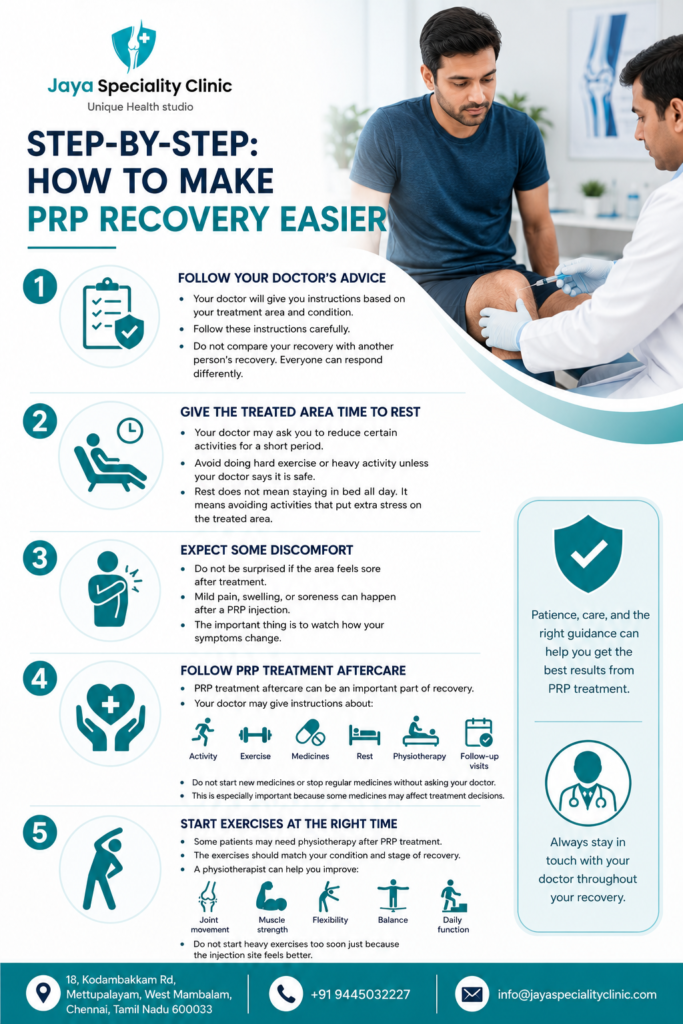
1. Follow Your Doctor’s Advice
Your doctor will give you instructions based on your treatment area and condition.
Follow these instructions carefully.
Do not compare your recovery with another person’s recovery. Everyone can respond differently.
2. Give the Treated Area Time to Rest
Your doctor may ask you to reduce certain activities for a short period.
Avoid doing hard exercise or heavy activity unless your doctor says it is safe.
Rest does not mean staying in bed all day. It means avoiding activities that put extra stress on the treated area.
3. Expect Some Discomfort
Do not be surprised if the area feels sore after treatment.
Mild pain, swelling, or soreness can happen after a PRP injection.
The important thing is to watch how your symptoms change.
4. Follow PRP Treatment Aftercare
PRP treatment aftercare can be an important part of recovery.
Your doctor may give instructions about:
- Activity.
- Exercise.
- Medicines.
- Rest.
- Physiotherapy.
- Follow-up visits.
Do not start new medicines or stop regular medicines without asking your doctor.
This is especially important because some medicines may affect treatment decisions.
5. Start Exercises at the Right Time
Some patients may need physiotherapy after PRP treatment.
The exercises should match your condition and stage of recovery.
A physiotherapist can help you improve:
- Joint movement.
- Muscle strength.
- Flexibility.
- Balance.
- Daily function.
Do not start heavy exercises too soon just because the injection site feels better.
How Long Is PRP Therapy Recovery Time?
There is no single recovery time for everyone.
It depends on:
- The condition being treated.
- The body part treated.
- The severity of the problem.
- Your general health.
- Your activity level.
- Your treatment plan.
Some people have soreness for a day or two after treatment. Results may take several weeks to become noticeable.
PRP is not an instant pain-relief treatment.
The body needs time to respond.
What to Expect After PRP Treatment
Knowing what to expect after PRP treatment can help you feel more comfortable.
First Few Days
You may notice some soreness, pain, or swelling around the injection area.
Following Weeks
Your symptoms may slowly begin to change.
Later Recovery
Some people may notice better pain control or movement over time. The response is different for each person.
Johns Hopkins notes that results for musculoskeletal PRP injections may become noticeable after several weeks.
PRP results are not guaranteed. Research is still developing, and the benefit can depend on the condition being treated.
What Are the Benefits of PRP Treatment?
The possible PRP treatment benefits depend on the condition.
PRP may be used as part of treatment for some:
- Joint problems.
- Tendon injuries.
- Ligament problems.
- Sports injuries.
- Early knee osteoarthritis.
- Chronic musculoskeletal pain.
PRP uses the patient’s own blood, which is why it is different from many other injection treatments.
However, PRP is not suitable for every person or every condition. A proper medical assessment is important before choosing treatment.
When Can You See PRP Treatment Results?
PRP treatment results do not usually appear immediately.
The body needs time to respond.
Some people may notice changes after a few weeks. In some cases, improvement may continue over a longer period.
The number of treatments needed can also vary.
Jaya Speciality Clinic states that the number of PRP sessions depends on the condition and that some patients may need one to three sessions.
Your doctor can decide whether another session is needed.
Who May Benefit From PRP?
PRP may be considered for some people with ongoing joint or soft-tissue problems.
Jaya Speciality Clinic lists conditions such as knee pain, early arthritis, shoulder problems, rotator cuff injuries, tennis elbow, ligament injuries, plantar fasciitis, sports injuries, and mild to moderate joint degeneration among conditions for which PRP may be considered.
But PRP is not automatically the best treatment for everyone.
A doctor should first check the cause of your pain.
When Should You Contact Your Doctor After PRP?

Mild soreness can happen after PRP.
However, contact your doctor if you have:
- Severe pain.
- Pain that keeps getting worse.
- Large or increasing swelling.
- Fever.
- Redness that is getting worse.
- Unusual discharge.
- New weakness or numbness.
- Any symptom that worries you.
These symptoms should be checked by a healthcare professional.
About Jaya Speciality Clinic
Jaya Speciality Clinic is an orthopaedic care centre in West Mambalam, Chennai. The clinic provides non-surgical and interventional orthopaedic care for joint, muscle, tendon, ligament, spine, and sports-related problems. PRP therapy is one of the treatments offered at the clinic.
The clinic is led by Dr. Balachandar M, MBBS, MS (Orthopaedics), Associate Consultant at Apollo Hospitals, Greams Road, Chennai. His qualifications listed by the clinic include FIAA (Netherlands), FASM (Italy), and FIJR.
Jaya Speciality Clinic follows a patient-focused, conservative-first approach. Treatment is planned based on the patient’s condition, symptoms, and needs.
Jaya Speciality Clinic
West Mambalam, Chennai
Phone: +91 94450 32227
Email: info@jayaspecialityclinic.com
Frequently Asked Questions About PRP Treatment
PRP treatment may cause mild pain or discomfort during the injection. Some soreness or swelling can happen after treatment.
You may feel a small needle prick, pressure, or short-term discomfort. The amount of pain is different for each person.
Mild pain or swelling may last for a day or two in some people. Recovery can vary based on the condition and treatment area.
Common effects include soreness, pain, swelling, and bruising around the injection area.
There is no fixed recovery time. Some people may have short-term soreness, while the treatment results can take several weeks to appear.
The right time depends on the area treated and your condition. Follow the activity instructions given by your doctor.
You may have temporary soreness or swelling. Improvement, if it occurs, usually takes time rather than happening immediately.
No. PRP results can vary. The treatment may help some conditions and patients more than others. Your doctor should assess whether it is suitable for you.
The number varies. Jaya Speciality Clinic states that some patients may need one to three sessions, depending on their condition.
PRP may be useful as part of treatment for selected conditions, but it cannot replace surgery in every case. The right treatment depends on the diagnosis.
Final Takeaway
So, is PRP treatment painful?
Usually, PRP treatment causes mild and temporary discomfort, rather than severe pain. You may feel a short sting during the injection and some soreness or swelling afterward.
The most important step is to have the right diagnosis first. Your doctor can then decide whether PRP is suitable and explain the expected PRP treatment procedure, recovery, aftercare, and possible results.