
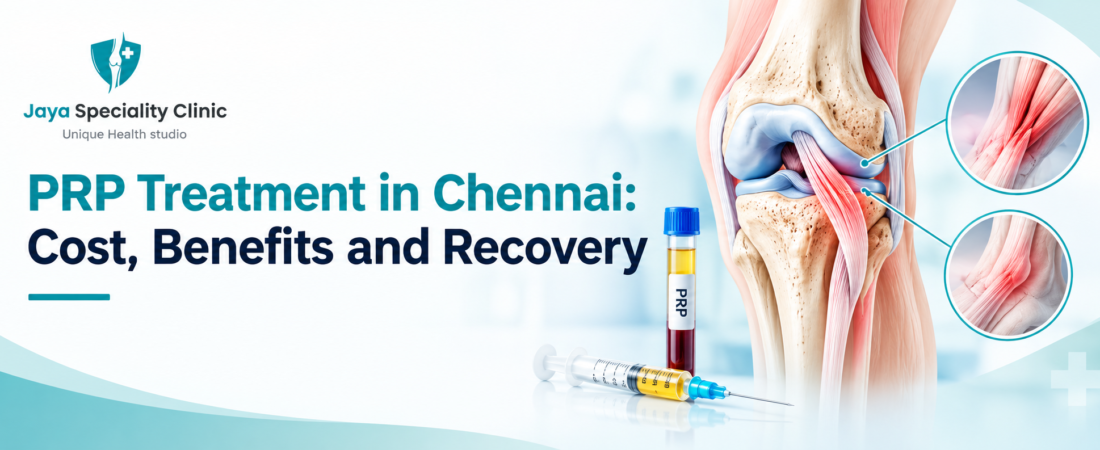
Persistent joint, ligament, or tendon pain can make simple activities such as walking, climbing stairs, exercising, or playing sports uncomfortable. When medicines, rest, or physiotherapy do not provide enough improvement, patients often start looking for other non-surgical treatment options. PRP Treatment in Chennai is one option that may be considered for selected musculoskeletal conditions. PRP, or platelet-rich plasma, uses a concentrated portion of the patient’s own blood and is injected into the affected area to support the body’s natural healing response.
Ligament and tendon injuries can be particularly frustrating because these tissues may take time to recover. Repeated strain, sports injuries, overuse, sudden movements, or age-related changes can lead to pain, tenderness, weakness, and reduced movement. Some injuries improve with rehabilitation and activity modification, while others may continue to cause symptoms. This is where a proper diagnosis becomes important. PRP for Ligament and Tendon Injuries may be considered in selected cases after an orthopaedic evaluation to determine whether the treatment is appropriate.
What Is PRP Treatment?
PRP stands for Platelet-Rich Plasma. During the procedure, a small amount of the patient’s blood is collected and processed to separate and concentrate the platelets. The prepared PRP is then injected into the targeted area.
Platelets contain biological substances involved in the body’s healing processes. The goal of PRP treatment is to place a concentrated platelet preparation at the site of an injury and support the local healing environment.
PRP is not a guaranteed cure, and it is not suitable for every injury. The expected benefit can depend on the location and severity of the problem, the type of PRP preparation used, overall health, and rehabilitation after treatment.
Why Do Ligament and Tendon Injuries Take Time to Heal?
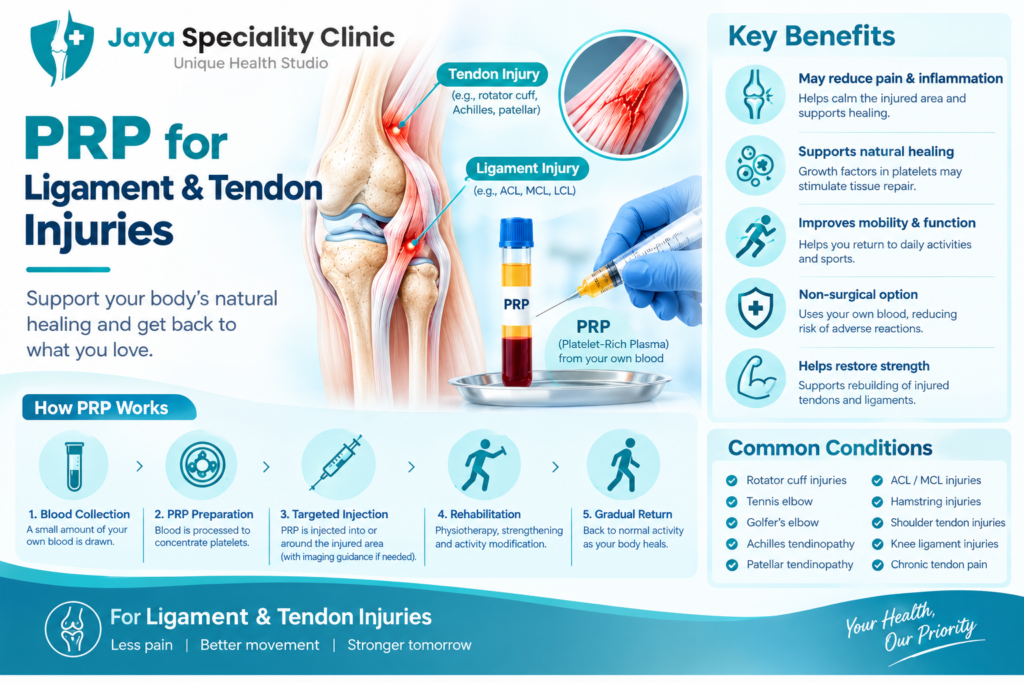
Ligaments connect bones to other bones, while tendons connect muscles to bones. Both are important for stability and movement.
When these tissues are injured, healing may be slower than patients expect. Some common reasons include:
- Limited blood supply in certain areas
- Repeated stress on the injured tissue
- Returning to sports or exercise too quickly
- Inadequate rehabilitation
- Chronic overuse
- Age-related tissue changes
- More severe or complex injuries
A person with a tendon or ligament injury may experience pain during movement, stiffness, swelling, weakness, or difficulty performing normal activities.
The first step should always be identifying the actual cause of the pain. Depending on the symptoms, an orthopaedic specialist may recommend a physical examination and, when required, imaging such as an X-ray, ultrasound, or MRI.
How Can PRP Help With the Problem?
Once the injury has been properly assessed, PRP may be considered as part of a broader treatment plan for selected patients.
The purpose is not simply to inject PRP and expect immediate healing. Instead, treatment may combine the injection with appropriate activity modification, physiotherapy, strengthening exercises, and gradual return to normal activity.
For patients searching for PRP for Ligament and Tendon Injuries, it is important to understand that PRP should be selected according to the specific injury rather than used as a one-size-fits-all treatment.
Step-by-Step PRP Treatment Process
1. Understand the Cause of Pain
The process begins with an orthopaedic assessment. Your doctor will evaluate your symptoms, movement, injury history, and physical findings.
This helps determine whether the problem is related to a ligament, tendon, muscle, joint, or another structure.
2. Assess Whether PRP Is Suitable
PRP may be considered for certain chronic tendon problems, selected sports injuries, and some ligament or soft-tissue conditions.
However, a complete tear, significant instability, fracture, infection, or another serious problem may require a different approach. PRP should therefore be recommended only after proper evaluation.
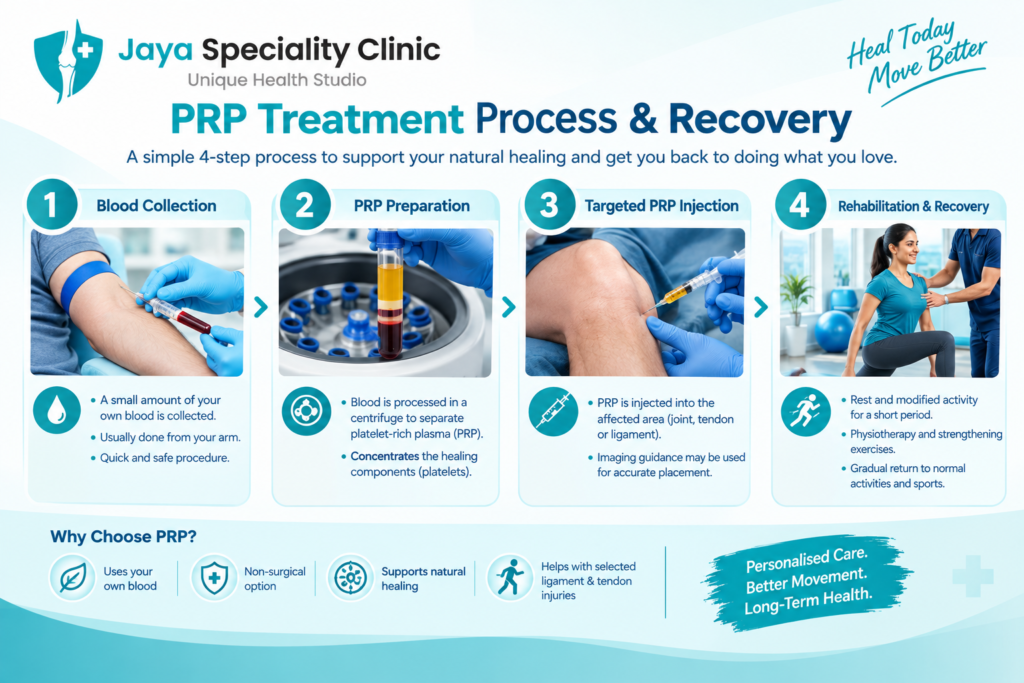
3. Blood Collection
If PRP is considered appropriate, a small amount of the patient’s own blood is collected.
Because the preparation uses the patient’s own blood, PRP is different from treatments that introduce a medication or donor-derived biological material.
4. PRP Preparation
The collected blood is processed to separate the platelet-rich portion from other blood components.
The exact preparation method can vary between clinical settings and treatment protocols.
5. Targeted Injection
The prepared PRP is injected into or around the affected area, depending on the injury and the treatment plan.
In selected cases, imaging guidance may be used to help accurately target the relevant structure.
6. Rehabilitation and Activity Modification
The injection is only one part of the recovery process.
Your doctor may recommend a period of modified activity followed by physiotherapy and progressive strengthening. The rehabilitation plan can help restore flexibility, strength, movement, and function.
7. Gradual Return to Normal Activity
Returning to exercise or sports too quickly can place unnecessary stress on healing tissues.
A gradual return is generally planned according to symptoms, strength, movement, and functional recovery.
Benefits of PRP Treatment
Potential benefits of PRP may include:
- Uses the patient’s own blood
- Non-surgical treatment option
- May support the body’s natural healing response
- Can be considered for selected tendon and ligament problems
- May be combined with physiotherapy and rehabilitation
- May help selected patients manage persistent musculoskeletal pain
However, benefits vary from person to person. PRP should not be promoted as a guaranteed solution for every ligament or tendon injury.
Medical evidence also varies depending on the specific condition. For example, professional guidance for some rotator-cuff conditions has found mixed or limited evidence for routine PRP use. This is why individual diagnosis and treatment selection are important.
PRP Treatment Cost in Chennai
One of the most common questions patients ask is, “How much does PRP treatment cost in Chennai?”
There is no single price that applies to every patient. The total cost can vary depending on several factors, including:
- The condition being treated
- The treatment area
- Number of PRP sessions recommended
- PRP preparation technique
- Whether imaging guidance is required
- Doctor consultation and evaluation
- Follow-up and rehabilitation requirements
Some patients may need a single session, while others may be advised more than one session depending on the condition and response to treatment.
Instead of choosing a clinic based only on the lowest price, patients should consider proper diagnosis, treatment suitability, clinical standards, and follow-up care.
PRP Recovery: What Should You Expect?
Recovery after PRP is not identical for everyone.
Some patients may experience temporary soreness, tenderness, or discomfort around the injection site. This can occur as the treated area responds to the procedure.
Your doctor will provide specific instructions regarding exercise, medicines, ice or heat, and activity restrictions. Following these instructions is important.
Improvement may take time rather than occurring immediately. Depending on the condition, patients may notice gradual changes over the following weeks. Rehabilitation can play an important role in maintaining progress.
If pain becomes severe, swelling increases significantly, or you develop unusual symptoms after treatment, contact your treating doctor for advice.
Who May Consider PRP Treatment?
PRP may be considered for selected patients with problems such as:
- Certain tendon injuries
- Selected ligament injuries
- Sports-related soft-tissue injuries
- Chronic tendon pain
- Selected knee conditions
- Some shoulder conditions
- Certain overuse injuries
PRP is not appropriate for every patient. A specialist should assess the injury before recommending treatment.
When Should You See an Orthopaedic Specialist?
Do not ignore persistent pain simply because it started after exercise or sports.
You should consider an orthopaedic evaluation if you have:
- Pain lasting for several weeks
- Repeated pain during exercise
- Joint instability
- Persistent swelling
- Weakness around the injured area
- Difficulty walking or using the affected limb
- Pain that returns whenever activity is resumed
Early evaluation can help identify the problem and prevent unsuitable self-treatment.
FAQ
PRP treatment uses a concentrated platelet preparation made from the patient’s own blood and injects it into a targeted area to support the body’s healing response.
PRP may be considered for selected ligament injuries, but suitability depends on the type and severity of the injury. A complete tear or significant instability may require other treatment.
PRP may be considered for certain chronic or persistent tendon conditions. The potential benefit varies according to the specific tendon problem and individual patient.
The number of sessions depends on the condition, treatment plan, and response. Some patients may require one session, while others may be advised additional sessions.
Some discomfort may occur during or after the injection. Your doctor can explain what to expect and how to manage temporary soreness.
Recovery varies according to the treated condition and individual response. A gradual return to activity and appropriate rehabilitation may be recommended.
PRP and surgery are not interchangeable treatments. PRP may be considered for selected conditions, while significant tears or structural problems may require surgical treatment. The appropriate option depends on the diagnosis.
PRP cost varies depending on the condition, number of sessions, preparation method, injection site, and clinical requirements. A consultation is needed to determine the appropriate treatment plan and cost.
About Jaya Speciality Clinic
Jaya Speciality Clinic is an orthopaedic care centre in West Mambalam, Chennai, providing conservative and interventional treatment for joint, spine, sports, ligament, and tendon-related problems.
The clinic follows a conservative-first approach, with treatment planned according to the patient’s condition. PRP therapy is one of the non-surgical options offered for selected joint, tendon, ligament, sports injury, and chronic pain conditions.
Orthopaedic care at the clinic is led by Dr. Balachandar M, MBBS, MS Ortho, Associate Consultant at Apollo Hospitals, Greams Road, Chennai.
Patients from West Mambalam and nearby areas such as T. Nagar, Kodambakkam, Ashok Nagar, Saidapet, Vadapalani, and Guindy can consult the clinic for evaluation and treatment planning.
Conclusion
Persistent ligament and tendon pain can affect work, exercise, sports, and everyday movement. PRP may be a useful non-surgical option for carefully selected patients, but it should not be viewed as a guaranteed cure.
The right approach starts with identifying the cause of pain, assessing the severity of the injury, deciding whether PRP is suitable, performing the procedure appropriately, and following a structured rehabilitation plan.
If you are considering PRP Treatment in Chennai, speak with an orthopaedic specialist to understand whether it is appropriate for your specific condition.