

If you are looking for sciatica pain relief, you know how debilitating this condition can be. That sharp, shooting pain travels from your lower back all the way down your leg, making it hard to sit at your desk in an OMR IT park or drive through heavy T. Nagar traffic. The burning sensation can ruin your entire day.
While a doctor’s visit is crucial for severe cases, mild to moderate sciatica pain often responds well to simple movements. In this guide, we break down exactly what causes sciatica, how to tell if your back pain is actually sciatica, and provide 5 easy exercises for sciatica relief that you can do right in your living room. If these home remedies do not help, we will also show you when it is time to seek advanced medical care.
What is Sciatica and Why Does it Hurt?
Sciatica is not a disease itself. It is a symptom of an underlying condition that affects the sciatic nerve—the longest nerve in your body. This nerve starts in your lower back, runs through your hips, and extends down each leg.
When this nerve gets compressed or irritated, it causes the classic radiating pain. The most common causes of this compression include:
- Herniated Discs: When the soft inner material of a spinal disc pushes out and presses on the nerve.
- Spinal Stenosis: Narrowing of the spinal canal, often due to age-related wear and tear.
- Piriformis Syndrome: A small muscle in your buttocks (the piriformis) tightens and spasms, pinching the nerve.
- Prolonged Sitting: A major issue for office workers and IT professionals in Chennai, as sitting for long hours puts immense pressure on the lower spine.
Sciatica vs. Regular Back Pain: How to Tell the Difference
Many people assume any lower back ache is sciatica, but the two conditions are quite different. Knowing the difference helps you choose the right treatment.
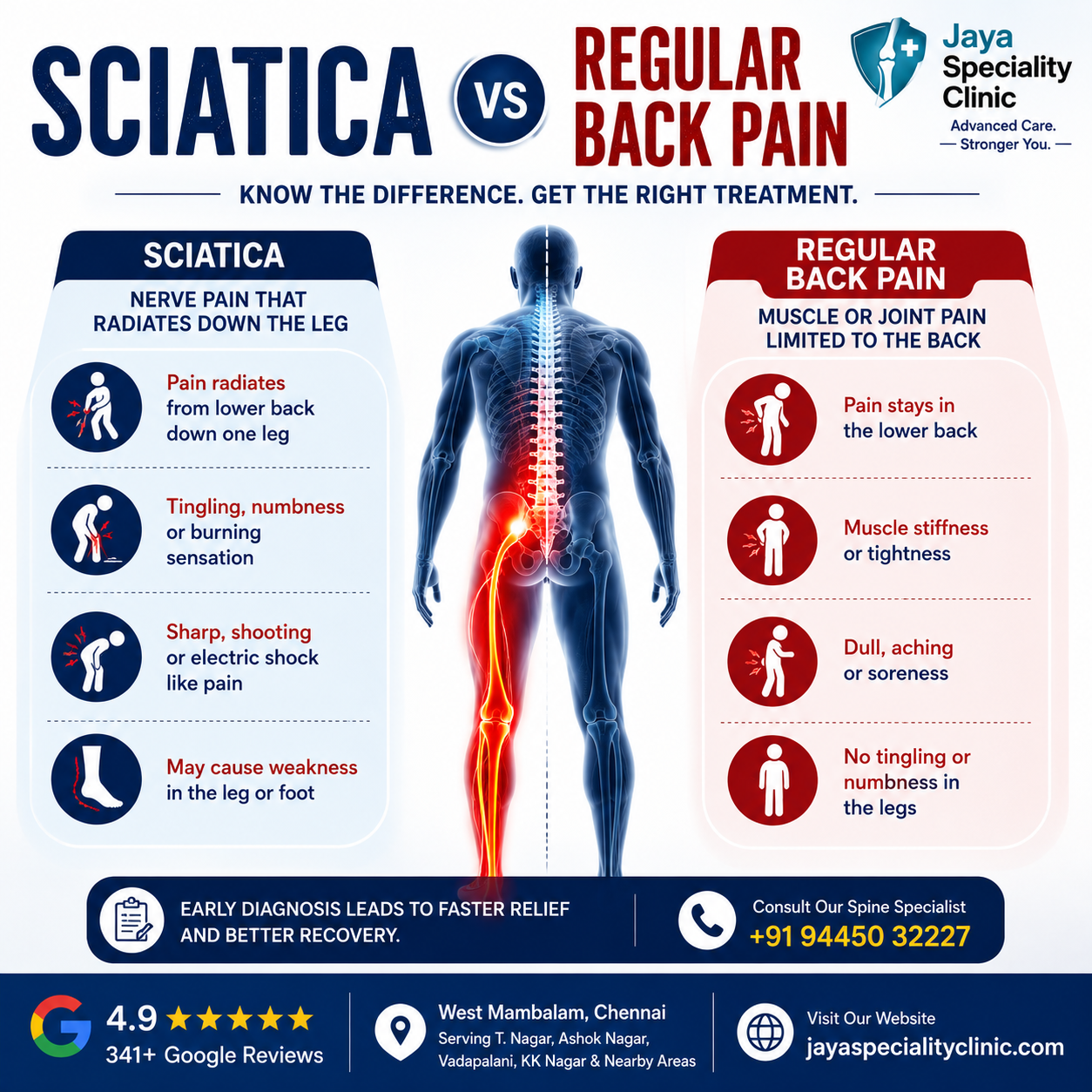
| Feature | Regular Lower Back Pain | Sciatica |
| Location | Stays in the lower back or buttocks | Radiates from the back down one leg |
| Pain Type | Dull, aching, or stiff | Sharp, shooting, or electric shock-like |
| Movement Impact | Hurts when you bend or lift | Hurts when you cough, sneeze, or sit |
| Nerve Symptoms | None (usually just muscle pain) | Tingling, numbness, or weakness in the leg/foot |
If your pain shoots down past your knee, it is highly likely that you are dealing with sciatica, not just a strained muscle.
5 Proven Exercises for Sciatica Relief at Home
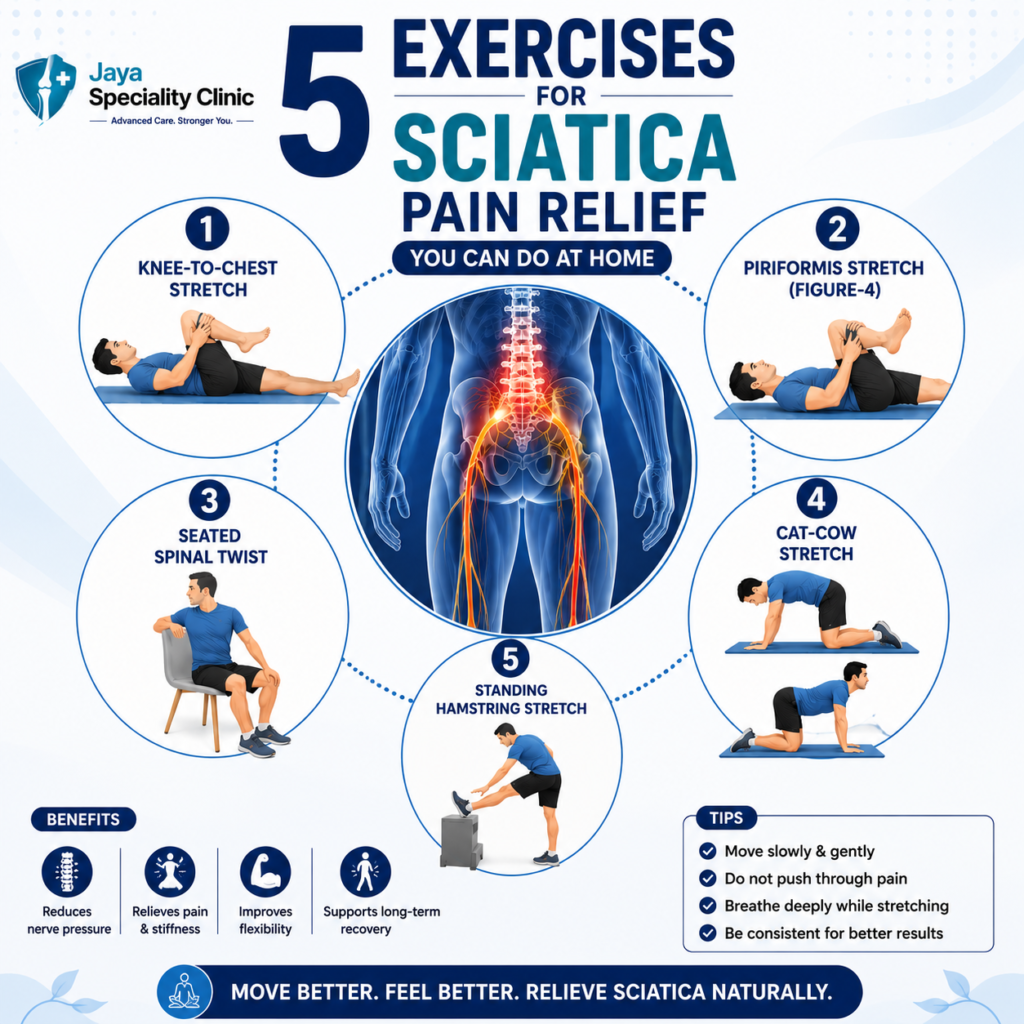
Gentle stretching and movement are the best ways to relieve pressure on the sciatic nerve. The key is to move slowly and never push through sharp pain. Perform these exercises on a comfortable mat or rug.
1. The Knee-to-Chest Stretch
This is one of the most effective stretches for soothing a spasming lower back and taking pressure off the spine.
- Lie flat on your back with both legs extended.
- Slowly bend your right knee and bring it toward your chest.
- Grab your knee with both hands and gently pull it closer until you feel a mild stretch in your lower back.
- Hold this position for 30 seconds.
- Release and repeat with your left leg. Do this 3 times for each leg.
2. The Piriformis Stretch (Figure-4)
The piriformis muscle often tightens after long hours of sitting and compresses the sciatic nerve. This stretch directly targets it.
- Lie on your back with your knees bent and feet flat on the floor.
- Cross your right ankle over your left knee.
- Reach through the gap between your legs, grab the back of your left thigh, and gently pull your left leg toward your chest.
- You should feel a deep stretch in your right buttock. Hold for 30 seconds.
- Switch legs and repeat.
3. The Seated Spinal Twist
Twisting the spine gently can help decompress the vertebrae and relieve nerve irritation.
- Sit upright on a chair with your feet flat on the floor.
- Cross your right leg over your left knee.
- Twist your upper body gently to the right, using your left elbow to push against the outside of your right knee.
- Keep your spine straight and hold the twist for 30 seconds.
- Repeat on the other side.
4. The Cat-Cow Stretch
Often used in yoga, this movement lubricates the spinal joints and relieves stiffness.
- Get down on your hands and knees (tabletop position).
- Slowly arch your back upward, tucking your chin toward your chest (the Cat pose).
- Then, drop your belly toward the floor, lifting your head and tailbone toward the ceiling (the Cow pose).
- Move slowly back and forth between these two positions.
- Repeat for 10 to 15 slow breaths.
5. The Standing Hamstring Stretch
Tight hamstrings pull on the pelvis, which can worsen sciatica pain. Stretching them takes the tension away from your lower back.
- Stand near a sturdy chair or wall for balance.
- Place your right heel on a slightly elevated surface (like a small step or a sturdy stool).
- Keep your leg straight and gently bend forward at the hips (do not round your back).
- Hold until you feel a stretch down the back of your thigh. Hold for 30 seconds.
- Switch to the left leg.
When to Stop Home Exercises and See a Doctor
Home exercises are wonderful for mild pain, but they are not a cure-all. You must stop the exercises and consult a doctor if you experience:
- Pain that gets worse with movement.
- Numbness or severe weakness in your leg or foot.
- Loss of bladder or bowel control (this is a medical emergency).
If your sciatica has lasted more than two weeks despite home exercises, it is time to see a specialist. At Jaya Speciality Clinic in West Mambalam, Chennai, we specialize in advanced, non-surgical treatments that can relieve severe sciatica without the need for invasive surgery.
Advanced Non-Surgical Treatments for Sciatica
If stretches and painkillers are not working, modern medicine offers excellent alternatives to surgery.
- Radiofrequency Ablation (RFA): This procedure uses heat to block the pain signals traveling along the nerve, providing long-lasting relief.
- PRP (Platelet-Rich Plasma) Therapy: Doctors draw a small amount of your blood, concentrate the healing platelets, and inject them into the injured area to reduce inflammation and promote tissue repair.
- Epidural Steroid Injections: A targeted injection that delivers powerful anti-inflammatory medication directly to the root of the nerve.
These treatments are minimally invasive, require little to no downtime, and are highly effective for chronic sciatica. Learn more about our Sciatica Treatment in Chennai services.
Frequently Asked Questions About Sciatica
For most people, acute sciatica lasts between 4 to 6 weeks. However, if the underlying cause (like a herniated disc) is not addressed, the pain can become chronic and return frequently.
Yes, short, gentle walks are excellent. Walking improves blood flow, reduces inflammation, and releases endorphins. However, avoid long walks on hard surfaces until the severe pain subsides.
In many cases, yes. With a combination of physical therapy, lifestyle changes, and targeted treatments like PRP or RFA, most patients achieve long-term, permanent relief without needing surgery.
The best position is usually on your side with a pillow placed between your knees. This keeps your hips aligned and takes pressure off the sciatic nerve. Alternatively, sleeping on your back with a pillow under your knees works well.
Sitting puts up to 40% more pressure on your spinal discs than standing. If you work an IT job in Chennai, make sure to stand up, stretch, and walk around for at least 5 minutes every hour.
About Jaya Speciality Clinic
Jaya Speciality Clinic is a trusted Orthopedic Clinic in Chennai, offering comprehensive care for back pain, sciatica, spine disorders, arthritis, sports injuries, and joint problems. Conveniently located in West Mambalam, the clinic serves patients from T. Nagar, Ashok Nagar, Vadapalani, Kodambakkam, KK Nagar, Saidapet, Guindy, and nearby areas.
Led by Dr. Balachandar M (MBBS, MS Orthopaedics), the clinic focuses on evidence-based diagnosis and personalized treatment plans. From physiotherapy and rehabilitation to advanced non-surgical procedures such as PRP Therapy, Radiofrequency Ablation (RFA), and image-guided injections, our goal is to relieve pain, improve mobility, and help patients return to their normal activities with confidence.
If persistent sciatica pain is affecting your work, sleep, or quality of life, our orthopedic team is here to help you find the most suitable treatment based on your condition.
Conclusion
Sciatica can make even simple daily activities like sitting, walking, or driving uncomfortable. Fortunately, many people experience significant relief through regular stretching, improved posture, and simple lifestyle changes. The five exercises discussed in this guide can help reduce pressure on the sciatic nerve and improve flexibility when performed correctly.
However, if your symptoms persist for more than two weeks, become more severe, or are accompanied by numbness, weakness, or difficulty walking, it is important to seek professional medical evaluation. Early diagnosis not only helps identify the underlying cause but also prevents long-term nerve damage and chronic pain.
At Jaya Speciality Clinic, we provide comprehensive evaluation and advanced non-surgical treatment options for sciatica, including personalized rehabilitation programs and minimally invasive pain management procedures. If you’re looking for effective Sciatica Pain Relief in Chennai, schedule a consultation with our orthopedic specialist and take the first step toward living pain-free.