
If you’re experiencing shoulder pain while lifting your arm, you’re not alone. This is one of the most common complaints orthopedic specialists see daily. Whether it’s reaching for a shelf, brushing your hair, or serving in badminton, that sharp catch of pain can be frustrating and alarming.
Most cases of shoulder pain while lifting your arm have a clear cause and can be treated without surgery. In this guide, we’ll cover the 5 most common causes, a simple home test, and treatment options available at Jaya Speciality Clinic in Chennai.
Quick Self-Assessment: What Your Pain Tells You
The location and timing of your pain can tell you a lot about the underlying issue.
| Where You Feel Pain | When It Happens | Most Likely Cause |
| Top of shoulder, outer arm | Mid-range of lifting (60-120 degrees) | Shoulder Impingement |
| Front of shoulder | Starting to lift, especially overhead | Biceps Tendinitis |
| Deep in the joint | Throughout the entire arc | Rotator Cuff Tear |
| Diffuse, all around | Lifting + lying on that side at night | Subacromial Bursitis |
| All directions, with stiffness | Any movement, especially rotation | Frozen Shoulder |
| Deep joint, gradual onset | Lifting + weight-bearing | Shoulder Osteoarthritis |
This table gives you a starting point, but these conditions often overlap.
The 5 Main Causes of Shoulder Pain While Lifting Your Arm
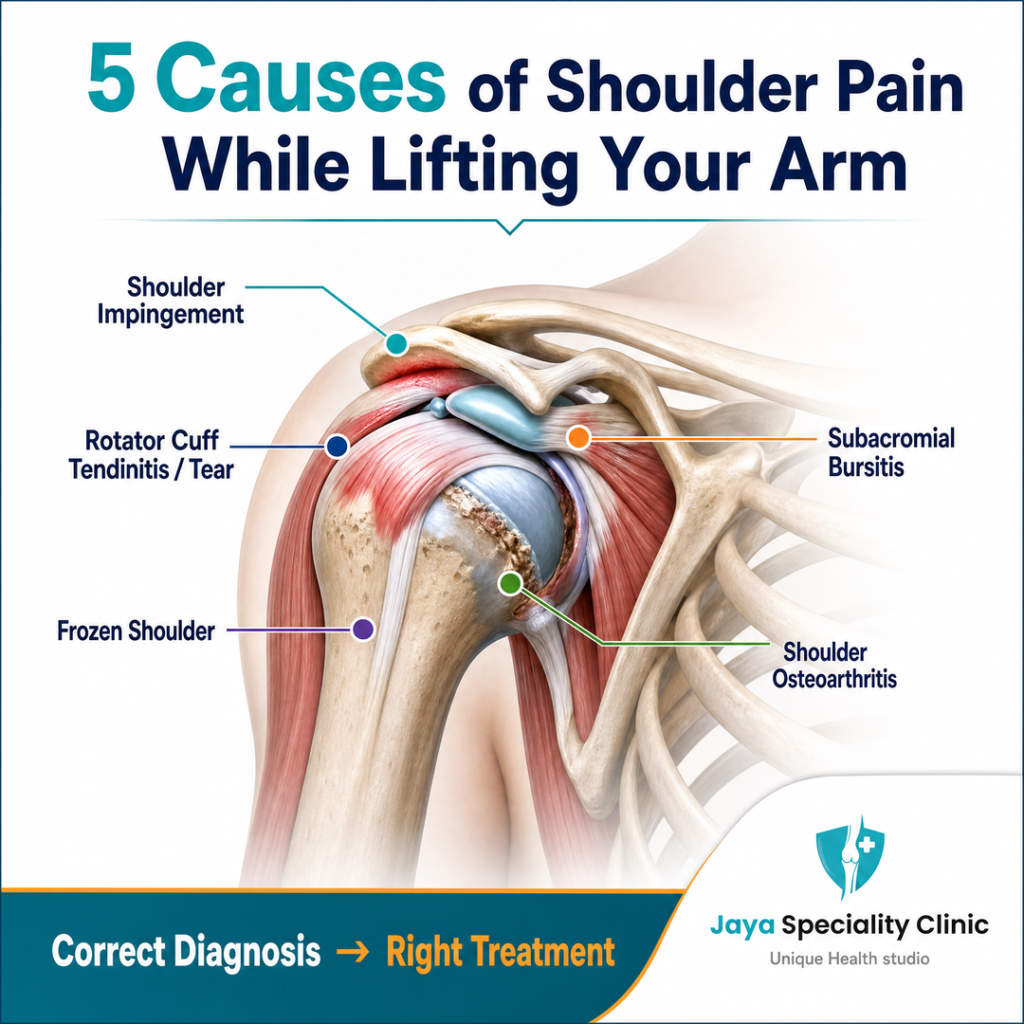
1. Shoulder Impingement Syndrome
This is the most common cause of shoulder pain while lifting your arm, especially in adults under 65. It happens when the rotator cuff tendons and the subacromial bursa get pinched between the head of your upper arm bone and the acromion (the bony roof of your shoulder).
The hallmark sign is what doctors call the “painful arc” — pain that appears when your arm is raised between 60 and 120 degrees, then eases once you push past that range. People in Chennai who work in IT, paint, hang curtains, or play overhead sports like badminton and tennis are particularly at risk.
2. Rotator Cuff Tendinitis or Tear
The rotator cuff is a group of four muscles and tendons that stabilize your shoulder joint. When these tendons become inflamed (tendinitis) or partially torn, lifting your arm — especially away from your body — causes sharp pain.
Key warning signs of a rotator cuff tear include significant weakness when lifting your arm to the side, pain that doesn’t improve after 4-6 weeks of rest, and an audible “pop” at the time of injury. Night pain is also a strong indicator.
3. Subacromial Bursitis
The subacromial bursa is a small fluid-filled sac that cushions the rotator cuff tendons against the acromion. When it becomes inflamed from overuse or repetitive overhead activity, it swells and causes a deep, aching pain that worsens with reaching overhead.
Bursitis rarely occurs alone. It’s usually found alongside shoulder impingement or rotator cuff tendinitis, which makes treatment more effective when all contributing factors are addressed together.
4. Frozen Shoulder (Adhesive Capsulitis)
Frozen shoulder is a progressive tightening of the shoulder joint capsule that restricts movement in every direction. It’s more common in women aged 40-60 and in people with diabetes or thyroid conditions.
Unlike impingement or bursitis, frozen shoulder causes stiffness alongside pain. Your arm may not lift past 90 degrees without significant resistance. Recovery typically takes 12-18 months, but early physiotherapy can shorten this timeline.
5. Shoulder Osteoarthritis
Osteoarthritis of the shoulder causes deep, aching pain felt inside the joint, particularly at the front. The pain develops gradually over months or years and worsens with activity.
In Chennai, this is more commonly seen in people over 50, especially those with a history of shoulder injury or those who have done heavy manual labor. The pain from arthritis is felt throughout the entire range of motion, not just in a specific arc.
The “Painful Arc” Test: Try This at Home
Here’s a simple self-assessment you can do right now:
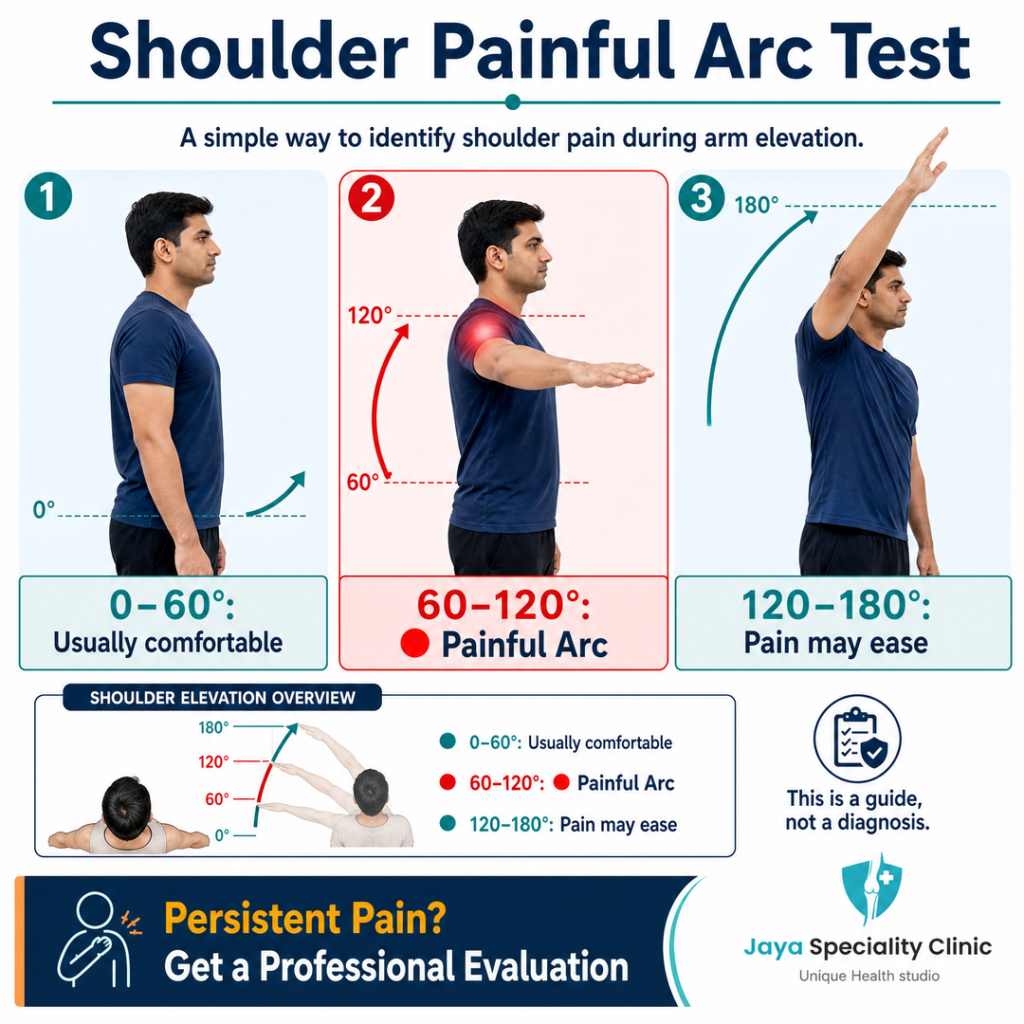
1.Stand with your arm at your side. Start raising your arm out to the side, slowly and smoothly.
2.Note when pain begins. If it starts around 60 degrees and peaks around 90-120 degrees, then eases as you raise your arm higher — that’s a classic “painful arc” pattern pointing to impingement.
3.Try raising your arm forward. If the pain occurs at a similar mid-range, it confirms the impingement pattern.
4.If pain is present throughout the entire arc — from start to finish — it’s more likely a rotator cuff tear or significant tendinopathy.
Important: This test is a guide, not a diagnosis. If you experience significant weakness, clicking, or your arm “gives way,” see a specialist promptly.
Treatment Options: Conservative-First Approach
At Jaya Speciality Clinic, we follow a conservative-first philosophy. Most cases respond well to non-surgical treatment.
Physiotherapy and Rehabilitation
A structured physiotherapy program focusing on rotator cuff strengthening, scapular stabilization, and posture correction is the foundation of treatment. Most patients see significant improvement within 6-12 weeks of consistent therapy.
PRP Therapy
Platelet-Rich Plasma (PRP) therapy involves injecting concentrated growth factors from your own blood into the damaged tendon. This promotes natural healing and is particularly effective for rotator cuff tendinitis and partial tears. PRP therapy in Chennai is available at Jaya Speciality Clinic with minimal downtime.
Radiofrequency Ablation (RFA)
For chronic pain that doesn’t respond to other treatments, radiofrequency ablation uses targeted heat to interrupt pain signals from the affected nerve. This provides long-lasting relief without surgery.
Corticosteroid Injections
A corticosteroid injection into the subacromial space can provide rapid relief from inflammation and pain, especially for bursitis. This allows patients to participate more effectively in physiotherapy.
For persistent cases that don’t respond to conservative care, Jaya Speciality Clinic offers expert evaluation and, if needed, minimally invasive arthroscopic options. Our team at the Shoulder Pain Treatment in Chennai center uses advanced diagnostics including ultrasound and MRI to identify the exact cause before recommending any treatment.
When Should You See a Doctor?
Don’t wait until the pain becomes unbearable. Seek professional evaluation if you experience:
•Pain persisting for more than 4-6 weeks despite rest
•Significant weakness when lifting your arm
•Pain that wakes you from sleep at night
•A “pop” sound followed by weakness after an injury
•Inability to lift your arm above shoulder height
•Numbness or tingling down your arm
Early intervention produces better outcomes.
FAQ: Shoulder Pain While Lifting Your Arm
The most common reason is shoulder impingement, where the rotator cuff tendons get pinched during arm elevation. Other causes include rotator cuff tears, bursitis, frozen shoulder, and osteoarthritis.
Pain during overhead movement usually points to subacromial impingement or rotator cuff tendinitis. The tendons get compressed in the narrow space between your arm bone and the acromion.
Most cases are not serious. However, if you experience sudden severe pain after an injury, significant weakness, your arm “giving way,” or pain that wakes you from sleep multiple nights in a row, seek medical evaluation.
Yes, in most cases. Research shows that 60-80% of patients with shoulder impingement improve with conservative treatment including physiotherapy, activity modification, and anti-inflammatory medications. PRP therapy and corticosteroid injections can further improve outcomes without surgery.
Gentle pendulum swings, passive forward flexion, and external rotation stretches are safe early exercises. Avoid overhead pressing and heavy lifting until evaluated. A physiotherapist can design a program specific to your condition.
About Jaya Speciality Clinic
Jaya Speciality Clinic is a trusted Orthopedic Clinic in West Mambalam, Chennai, providing comprehensive care for shoulder pain, sports injuries, arthritis, rotator cuff conditions, and other musculoskeletal problems. Led by Dr. Balachandar M, Senior Orthopaedic Surgeon, the clinic focuses on accurate diagnosis and personalized treatment based on the underlying cause of shoulder pain. Patients can receive conservative treatment options such as physiotherapy, rehabilitation, injections, and other minimally invasive treatments when appropriate, with advanced evaluation including ultrasound and MRI when clinically required.
Conclusion
Shoulder pain while lifting your arm is a symptom, not a diagnosis. The 5 main causes — impingement, rotator cuff injury, bursitis, frozen shoulder, and osteoarthritis — each require a different approach. The “painful arc” test can help you narrow down the likely cause, but a proper clinical examination with imaging is essential for accurate diagnosis and effective treatment.
If you’re in Chennai and experiencing shoulder pain while lifting your arm, don’t ignore it. Early conservative treatment can prevent the condition from worsening and help you return to your daily activities pain-free.