

Shoulder pain does not always come from a fall, accident, or sports injury. You may wake up with pain, feel pain while lifting your arm, or notice a dull ache while sitting or sleeping. Shoulder pain without injury can come from problems in the shoulder joint, muscles, tendons, or nearby tissues. Pain can also come from the neck or, less often, another part of the body.
Many people search for left shoulder pain without injury or right shoulder pain without injury because the pain can start suddenly without an obvious reason. It may come and go or become worse at night. In women, shoulder pain can sometimes be linked to the same common shoulder problems seen in men. However, sudden shoulder or arm pain with chest pressure, breathing trouble, sweating, nausea, or unusual weakness can sometimes be a sign of a heart problem and needs emergency medical help.
What Causes Shoulder Pain Without Injury?
There are several possible causes.
1. Rotator Cuff Problems
The rotator cuff is a group of muscles and tendons around the shoulder.
These tissues help you lift and move your arm.
They can become irritated over time because of repeated movement, overhead work, heavy lifting, or age-related changes. Rotator cuff problems can cause a dull shoulder ache, weakness, and pain at night.
You may find it hard to:
- Lift your arm.
- Reach overhead.
- Comb your hair.
- Reach behind your back.
- Sleep on the painful side.
2. Bursitis
Small fluid-filled sacs called bursae help reduce rubbing around the joints.
When a bursa becomes irritated, it can cause shoulder pain and stiffness. Bursitis may become worse when you move the shoulder or press on the area.
This can happen even when there was no single injury.
3. Frozen Shoulder
Frozen shoulder can cause pain and stiffness.
At first, pain may be the main problem. Later, the shoulder may become harder to move.
Simple tasks like wearing clothes, reaching for something, or raising your arm can become difficult.
Treatment depends on the stage and cause of the problem.
4. Tendon Problems
Shoulder tendons can become irritated because of repeated use.
This can happen in people who:
- Work with their arms raised.
- Lift things often.
- Play sports.
- Exercise regularly.
- Do repeated shoulder movements.
Pain may be worse when you use the arm.
5. Arthritis
Arthritis can affect the shoulder joint.
It may cause:
- Pain.
- Stiffness.
- Reduced movement.
- Clicking or grinding.
- Difficulty with daily activities.
Shoulder arthritis can develop slowly. There may be no sudden injury before the pain starts.
6. Neck Problems
Sometimes the shoulder is not the real source of the pain.
A problem in the neck can irritate a nerve and cause pain that travels toward the shoulder or arm. It may also cause tingling, numbness, or weakness.
This is one reason why finding the exact source of pain is important.
What About Sudden Sharp Shoulder Pain That Comes and Goes?

Sudden sharp shoulder pain that comes and goes can have many causes.
The pain may happen when you:
- Move your arm.
- Reach overhead.
- Turn your neck.
- Sleep on one side.
- Do repeated work.
- Exercise.
A tendon, bursa, joint, or nerve may be involved.
Do not assume that sudden pain is always a muscle problem. If the pain is severe, keeps returning, or affects your normal activities, it is better to have it checked.
What Causes Shoulder Pain in Women?
People often search for causes of shoulder pain in female or sudden shoulder pain without injury woman.
Most common shoulder problems can affect both men and women. These include rotator cuff problems, bursitis, frozen shoulder, tendon problems, arthritis, and neck-related pain.
But women should pay special attention to sudden shoulder or arm pain when it happens with other symptoms.
Women may have heart attack symptoms that include shoulder, upper back, neck, jaw, or arm pain. Other symptoms may include shortness of breath, nausea, sweating, dizziness, unusual tiredness, or chest pressure. A heart attack can sometimes happen without strong chest pain.
If shoulder pain occurs with chest pressure, breathing difficulty, sweating, nausea, faintness, or pain spreading to the arm, jaw, or back, seek emergency medical help immediately.
What About Left Shoulder Pain Without Injury?
Left shoulder pain without injury does not always mean a heart problem.
It may be caused by:
- Rotator cuff problems.
- Bursitis.
- Frozen shoulder.
- Arthritis.
- Tendon irritation.
- Neck problems.
- Overuse.
However, left shoulder or arm pain with chest discomfort, shortness of breath, sweating, nausea, dizziness, or pain spreading to the jaw or back should be treated as an emergency.
What About Right Shoulder Pain Without Injury?
Right shoulder pain without injury can also have many causes.
It may come from the shoulder joint, tendons, muscles, or neck.
Common causes include:
- Rotator cuff problems.
- Bursitis.
- Frozen shoulder.
- Arthritis.
- Tendon irritation.
- Overuse.
- Neck nerve problems.
Pain that continues or becomes worse should be checked by a doctor.
Step-by-Step: How to Find the Cause of Shoulder Pain
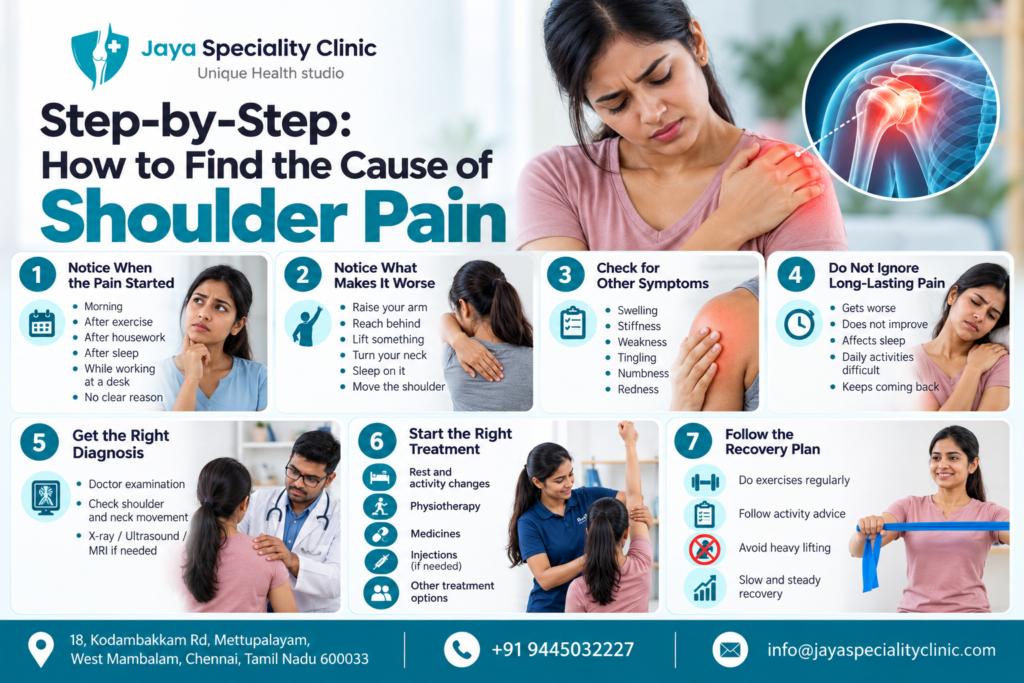
Step 1: Notice When the Pain Started
Think about when you first noticed the pain.
Did it start:
- In the morning?
- After exercise?
- After housework?
- After sleeping on one side?
- While working at a desk?
- Without any clear reason?
This information can help your doctor understand the problem.
Step 2: Notice What Makes It Worse
Check if the pain increases when you:
- Raise your arm.
- Reach behind your back.
- Lift something.
- Turn your neck.
- Sleep on the shoulder.
- Move the shoulder.
Pain that changes with shoulder movement may point toward a shoulder problem. Pain that does not change with shoulder movement can sometimes come from another source.
Step 3: Check for Other Symptoms
Look for:
- Swelling.
- Stiffness.
- Weakness.
- Tingling.
- Numbness.
- Fever.
- Redness.
- Reduced movement.
Tell your doctor about all these symptoms.
Step 4: Do Not Ignore Long-Lasting Pain
Mild shoulder pain may improve with simple care.
However, see a healthcare professional if the pain:
- Gets worse.
- Does not improve.
- Affects sleep.
- Makes daily activities difficult.
- Makes arm movement difficult.
- Keeps coming back.
The NHS advises seeking medical help when shoulder pain is getting worse or has not started to improve after about two weeks.
Step 5: Get the Right Diagnosis
A doctor will ask about your pain and examine your shoulder.
They may check:
- Shoulder movement.
- Arm strength.
- Joint stability.
- Tender areas.
- Neck movement.
- Nerve symptoms.
Sometimes an X-ray, ultrasound, MRI, or another test may be needed.
The test depends on the symptoms and the suspected cause.
The goal is simple: find the real reason for the pain before starting treatment.
Step 6: Start the Right Treatment
Treatment depends on the cause.
It may include:
Rest and Activity Changes
Avoid movements that make your pain worse.
But do not completely stop moving the shoulder unless your doctor tells you to. Gentle movement can be helpful for many shoulder problems.
Physiotherapy
Physiotherapy can help improve:
- Shoulder movement.
- Muscle strength.
- Flexibility.
- Joint function.
Medicines
Your doctor may recommend suitable medicines for pain or inflammation when needed.
Injections
Some patients may benefit from injections for certain shoulder conditions.
Other Treatment
If symptoms do not improve with non-surgical treatment, your orthopaedic doctor may discuss other options based on the diagnosis.
Step 7: Follow the Recovery Plan
Do not stop treatment as soon as the pain becomes better.
Complete the recommended exercises and follow activity advice.
Avoid suddenly returning to heavy lifting or intense exercise.
A slow and steady recovery can help protect the shoulder.
When Should You See an Orthopaedic Doctor?
You should consider seeing an orthopaedic doctor if:
- Shoulder pain continues.
- Pain keeps coming back.
- You cannot lift your arm properly.
- Your shoulder feels weak.
- You have ongoing stiffness.
- Pain affects your sleep.
- Pain affects your work or daily activities.
- You have numbness or tingling.
- The shoulder becomes swollen or red.
Jaya Speciality Clinic recommends an orthopaedic assessment when shoulder pain continues for more than 1–2 weeks or affects daily activities.
When Is Shoulder Pain an Emergency?
Most shoulder pain is not an emergency.
But get emergency medical help if shoulder or arm pain happens with:
- Chest pressure or tightness.
- Trouble breathing.
- Cold sweating.
- Fainting or severe dizziness.
- Nausea or vomiting.
- Pain spreading to the jaw, back, or arm.
These can be signs of a heart problem. Women may sometimes have less typical heart attack symptoms.
Also seek urgent medical care for sudden severe shoulder pain with major swelling, inability to move the arm, deformity, or a serious injury.
Simple Ways to Protect Your Shoulder
You can take some simple steps to keep your shoulders healthy.
Keep Good Posture
Sit upright and avoid keeping your neck and shoulders forward for long periods.
Take Breaks
If your work needs repeated arm movements, take short breaks.
Exercise Safely
Start slowly and use the correct technique.
Avoid Heavy Loads
Do not suddenly lift heavy objects if your shoulder is weak or painful.
Keep Moving
Gentle movement can help maintain shoulder mobility.
Treat Pain Early
Do not wait for shoulder pain to become severe before getting help.
About Jaya Speciality Clinic
Jaya Speciality Clinic is an orthopaedic clinic in West Mambalam, Chennai. The clinic provides care for shoulder pain, knee pain, sports injuries, arthritis, back pain, neck pain, and other bone and joint problems. Its approach focuses on accurate diagnosis, non-surgical treatment when appropriate, pain relief, and restoring movement.
The clinic is led by Dr. Balachandar M, MBBS, MS (Orthopaedics), with qualifications including FIAA (Netherlands), FASM (Italy), and FIJR. He is listed by the clinic as Associate Consultant – Apollo Hospitals, Greams Road, Chennai.
Treatment may include clinical assessment, imaging when needed, physiotherapy, rehabilitation, and other suitable orthopaedic treatments. The clinic follows a conservative-first approach and considers surgery only when it is needed.
Jaya Speciality Clinic
West Mambalam, Chennai
Phone: 94450 32227
Email: info@jayaspecialityclinic.com
Frequently Asked Questions
Shoulder pain can happen because of tendon problems, bursitis, frozen shoulder, arthritis, rotator cuff problems, overuse, or neck-related nerve pain.
Not always. It can come from a normal shoulder problem. But left shoulder or arm pain with chest pressure, breathing trouble, sweating, nausea, or dizziness needs emergency medical help.
Common causes include rotator cuff problems, bursitis, frozen shoulder, arthritis, tendon irritation, overuse, and neck problems.
It may be linked to a tendon, muscle, joint, bursa, or nerve. If the pain is severe or keeps returning, see a doctor.
Yes. Neck problems can cause pain that travels into the shoulder or arm. Numbness, tingling, or weakness may also occur.
Rotator cuff problems and other shoulder conditions can cause pain that is worse at night.
See an orthopaedic doctor if pain continues, gets worse, affects sleep or daily activities, or causes weakness or reduced movement.
Many shoulder problems can improve with non-surgical care such as activity changes, medicines, physiotherapy, and other treatments. The correct treatment depends on the cause.
Yes. Women can have heart attack symptoms that include shoulder, arm, back, neck, or jaw pain, sometimes with little or no chest pain.
If shoulder pain is getting worse or has not started to improve after about two weeks, arrange a medical assessment. Seek emergency help sooner if you have severe symptoms or possible heart-related symptoms.