
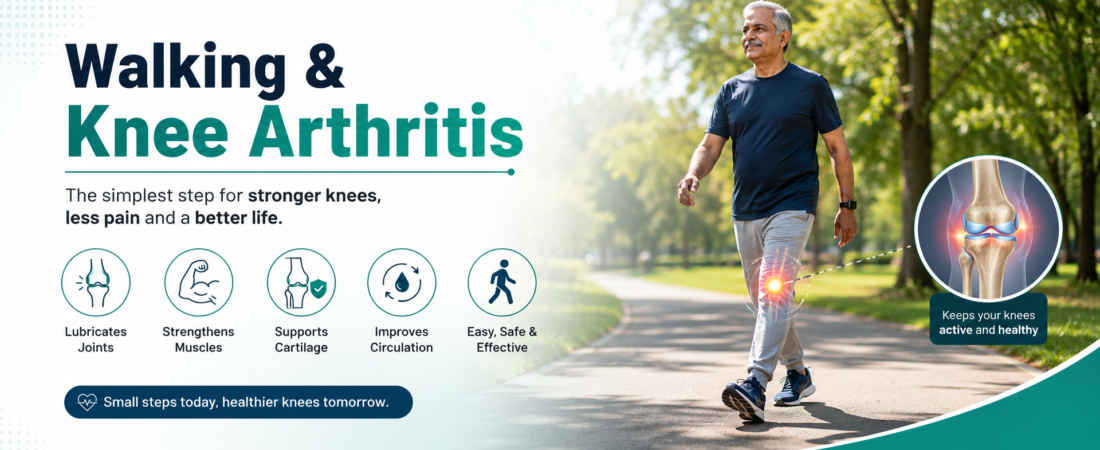
Walking vs Running: Which is better for knee arthritis? The answer might surprise you. Most people assume that running damages the knees and walking is always safer. But recent medical research shows that both activities can actually help manage knee arthritis — when done correctly. If you have knee arthritis and live in Chennai, this guide will tell you exactly when to walk, when to run, and how to protect your joints for years to come.
The Simple Answer First
For most people with knee arthritis, walking is the safer starting point. It puts less force on your joints, is easy to do daily, and helps keep your knees lubricated. However, if your arthritis is mild and your doctor approves it, running can actually strengthen your bones and protect your cartilage — science has proven this.
The key is not choosing one over the other. It is choosing the right activity for your current knee condition.
How Much Force Do Your Knees Absorb?
Every time your foot hits the ground, your knees absorb impact. The amount of force depends on whether you walk or run:
| Activity | Impact Force | Joint Stress Level | Best For |
| Walking | 1–1.5 times body weight | Low | All stages of knee arthritis |
| Jogging | 2–2.5 times body weight | Moderate | Mild arthritis only |
| Running | 2.5–3.5 times body weight | High | Mild arthritis + strong muscles |
This means that if you weigh 70 kg, walking puts about 70–105 kg of force on your knees, while running puts about 175–245 kg. That is why walking is recommended for moderate to severe arthritis — and why running needs more caution.
5 Benefits of Walking for Knee Arthritis
Walking is often called “nature’s medicine” for knee arthritis. Here is why:
- Lubricates your joints — Walking increases the flow of synovial fluid (the natural oil inside your joints), which reduces friction and pain.
- Strengthens leg muscles — Your quads, hamstrings, and glutes act like shock absorbers. Walking builds these muscles without stressing the joint.
- Maintains cartilage health — A 2022 study found that people with knee osteoarthritis who walk regularly are significantly less likely to develop worse pain.
- Improves blood circulation — Better blood flow brings nutrients to your joints and removes inflammatory waste products.
- Easy to do anywhere — You can walk at Marina Beach, in your neighborhood park, or even inside your house during monsoon season.
The Surprising Truth About Running and Knee Arthritis
Here is what most people get wrong: running does NOT cause knee arthritis. In fact, research shows the opposite.
A 2023 systematic review published in the Orthopaedic Journal of Sports Medicine analyzed 17 studies with over 14,000 patients. The findings were clear:
“In the short term, running is not associated with worsening signs of knee osteoarthritis and may be protective against generalized knee pain.”
Even more interesting — the study found that nonrunners had a higher risk of needing knee replacement surgery (4.6%) compared to runners (2.6%). This is because running stimulates bone density and strengthens the muscles around the knee joint.
So if you have mild knee arthritis and your doctor approves, running can be beneficial. But if you have moderate or severe arthritis, walking is the better choice until your knee strength improves.
Check Our Knee Arthritis In Chennai .
When to Walk and When to Run: A Simple Guide
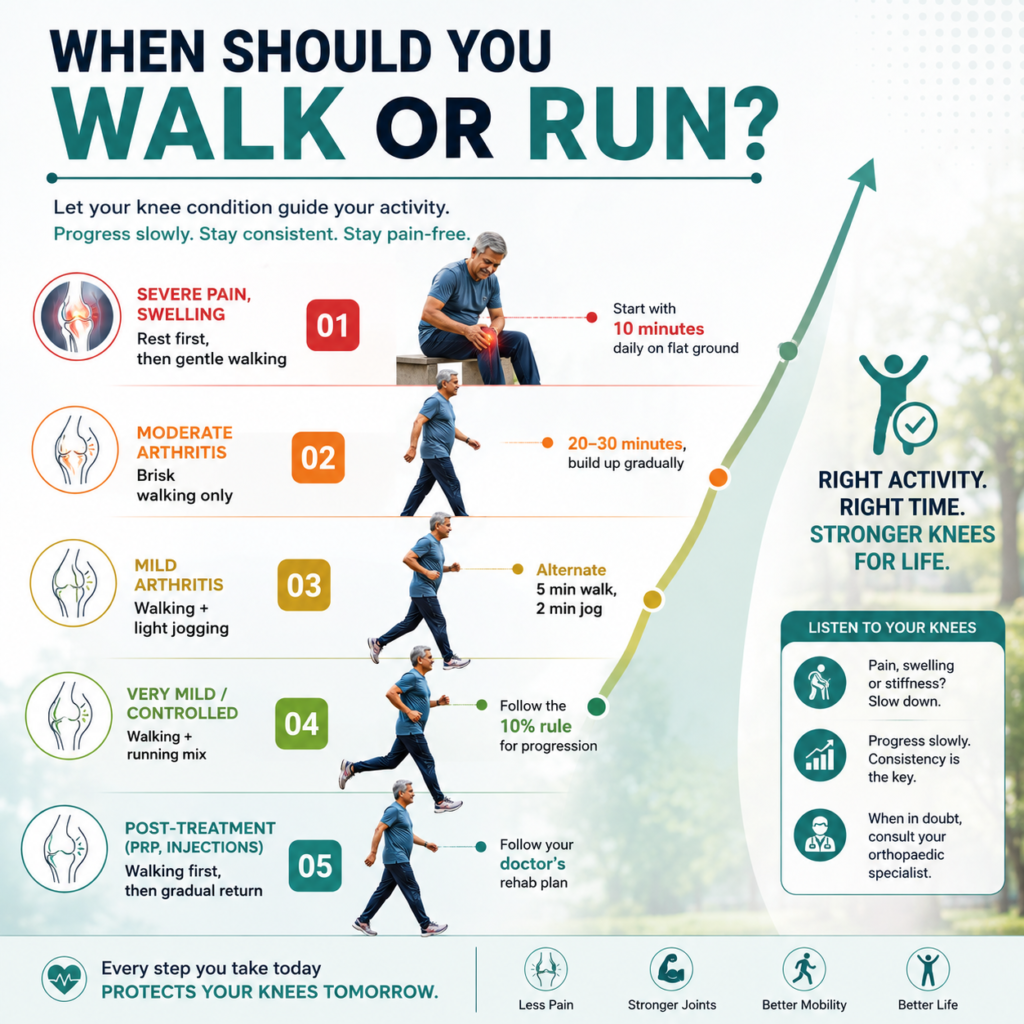
Here is how to decide based on your knee arthritis stage:
| Your Knee Condition | Best Activity | How to Start |
| Severe pain, swelling | Rest first, then gentle walking | 10 minutes daily on flat ground |
| Moderate arthritis | Brisk walking only | 20-30 minutes, build up gradually |
| Mild arthritis | Walking + light jogging | Alternate 5 min walk, 2 min jog |
| Very mild / controlled | Walking + running mix | Follow the 10% rule for progression |
| Post-treatment (PRP, injections) | Walking first, then gradual return | Follow your doctor’s rehab plan |
The 10% Rule: How to Progress Safely
Whether you walk or run, never increase your distance or time by more than 10% per week. This gives your joints, cartilage, and muscles time to adapt. For example:
- Week 1: Walk 20 minutes daily
- Week 2: Walk 22 minutes daily
- Week 3: Walk 24 minutes daily
- Week 4: Walk 26 minutes + add 2 minutes of jogging
This slow progression prevents flare-ups and keeps your knees healthy long-term.
Chennai-Specific Tips for Walking and Running
Living in Chennai comes with unique challenges for knee arthritis patients:
Heat and humidity: Walk or jog early morning (6-7 AM) or evening (6-7 PM) to avoid peak heat. The humidity in Chennai can increase joint stiffness — warm up for 5 minutes before starting.
Best surfaces: Marina Beach sand (wet, firm sand near the water), Guindy National Park trails, or your local park’s rubber track are gentler on knees than concrete sidewalks.
Footwear matters: In Chennai’s monsoon, waterproof walking shoes with good cushioning protect your knees from hard, wet surfaces. Replace shoes every 500-800 km.
Indian lifestyle factor: If you use Indian-style toilets or sit cross-legged frequently, these positions add extra stress to arthritic knees. Walking strengthens the muscles that compensate for this daily stress.
At Jaya Speciality Clinic in West Mambalam, Chennai, our orthopedic team specializes in these non-surgical treatments. We help patients return to walking and running safely — without surgery.
Frequently Asked Questions
Walking is better for most people with knee arthritis because it puts less force on the joints (1-1.5x body weight vs 2.5-3.5x for running). However, research shows that mild arthritis patients who run regularly actually have a lower risk of knee replacement. Start with walking and progress to running only with your doctor’s approval.
No — studies show that running does not worsen knee arthritis in the short term and may even protect against knee pain. A 2023 review of 17 studies found no significant difference in cartilage damage between runners and nonrunners. The key is proper form, good footwear, and gradual progression.
Start with 10-15 minutes daily and increase by 5 minutes each week. Most people with knee arthritis benefit from 30 minutes of walking daily. If pain increases during or after walking, reduce the time and consult your doctor.
No. Multiple studies confirm that recreational running does not increase the risk of knee arthritis. In fact, runners often have stronger bones and lower knee replacement rates. The danger comes from poor form, wrong footwear, or running through pain — not from running itself.
Lower-impact aerobic exercises are best: walking, cycling, and swimming. Walking is the most accessible. Cycling and swimming are excellent alternatives on days when walking causes discomfort. Strength training for the legs (squats, lunges, step-ups) is equally important for long-term joint health.
About Jaya Speciality Clinic
Jaya Speciality Clinic in West Mambalam, Chennai, provides personalized orthopaedic care for knee arthritis and other joint conditions. The clinic focuses on non-surgical treatment options, physiotherapy, and rehabilitation to help patients manage pain and stay active. Each treatment plan is tailored to the patient’s knee condition, lifestyle, and activity goals.
Conclusion
Walking is generally the safest starting point for people with knee arthritis, while running may be suitable for those with mild, well-controlled arthritis and good knee strength. The right exercise depends on your individual condition. If knee pain, swelling, or stiffness continues, consult an orthopaedic specialist before increasing your activity. With the right guidance and treatment, you can keep moving and protect your knee health.