
Do you have knee pain or joint pain? Are you thinking about PRP or physiotherapy? Both can help you feel better. But they work in different ways.
PRP is a treatment made from your own blood. Physiotherapy uses simple body exercises to make your muscles and joints strong.
But which one is better? It depends on your pain and the problem you have.
Some people may get better with physiotherapy. Some may need PRP treatment. A few people may need both.
In this blog, let us learn about PRP, physiotherapy, their good points, cost, and how long it may take to get better.
What Is PRP Treatment?
PRP means Platelet-Rich Plasma. It is made using a small amount of your own blood.
First, the doctor takes a little blood from your arm. Then, the blood is put into a special machine. The machine spins the blood and takes out the part with more platelets.
Platelets are tiny parts in your blood. They help your body heal.
The doctor then puts this part of the blood into the painful area. It may be given in the knee, shoulder, or a hurt tendon.
PRP may help some people with joint pain and sports injuries. But it does not work for everyone. It cannot fix all kinds of joint or muscle problems.
What Is Physiotherapy?
Physiotherapy is a way to help your body move better. It uses easy exercises and body movements.
A physiotherapist checks where you have pain. They also check how well you can move your arms, legs, and joints.
Then, they make an exercise plan just for you.
Physiotherapy may include:
- Easy exercises to make muscles strong.
- Stretching to help your body move freely.
- Exercises to help you keep your balance.
- Walking practice.
- Simple ways to sit, stand, and walk.
- Exercises to help you get better after an injury or surgery.
Physiotherapy can help reduce pain. It can also help you move better and make your muscles strong.
Is PRP Better Than Physiotherapy?
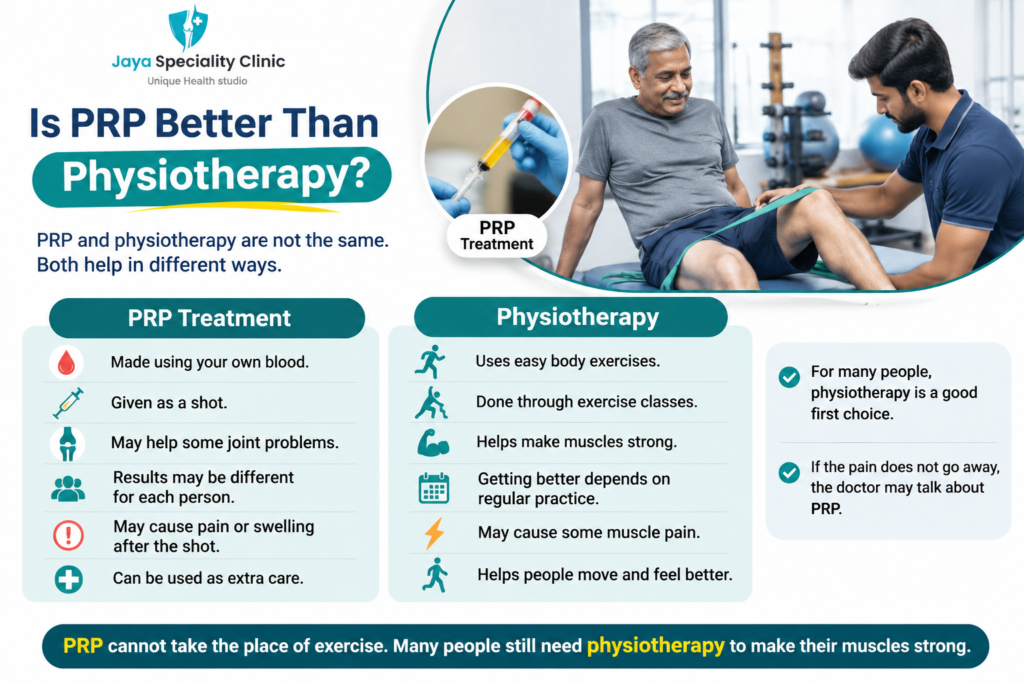
PRP and physiotherapy are not the same. Both help in different ways.
PRP is a shot made from your own blood. It may help some people with knee pain and tendon pain.
Physiotherapy helps your muscles become strong. It also helps your joints move better.
For many people, physiotherapy is a good first choice. If the pain does not go away, the doctor may talk about PRP.
Let us see how they are different.
| PRP Treatment | Physiotherapy |
| Made using your own blood. | Uses easy body exercises. |
| Given as a shot. | Done through exercise classes. |
| May help some joint problems. | Helps make muscles strong. |
| Results may be different for each person. | Getting better depends on regular practice. |
| May cause pain or swelling after the shot. | May cause some muscle pain. |
| Can be used as extra care. | Helps people move and feel better. |
PRP cannot take the place of exercise. Many people still need physiotherapy to make their muscles strong.
What Are the Benefits of PRP Treatment?
PRP may help some people with knee pain and other joint problems.
Some good points of PRP are:
- It is made from your own blood.
- It may help lower pain.
- It may help you move your joint better.
- It may help some people when other care has not worked well.
- It can be used with other care.
But PRP does not give the same result to everyone. Some people may feel better. Others may not get much help.
More studies are needed to know who can get the most help from PRP.
What Are the Benefits of Physiotherapy?
Physiotherapy helps your body become strong and move well.
Some good points are:
- Makes your muscles strong.
- Helps your joints move better.
- Helps lower body pain.
- Makes walking easier.
- Helps you keep your balance.
- Helps you get better after sports injuries.
- Helps you get well after surgery.
- Makes your daily work easier.
Physiotherapy can help people with knee pain, shoulder pain, back pain, and many other body problems.
Doing the right exercises every day can help you feel better.
PRP Treatment for Knee Pain
Knee pain is a common problem. It can happen as we grow older. It can also happen because of sports injuries or damage to the knee.
Some people find it hard to walk, climb steps, or stand for a long time because of knee pain.
PRP treatment for knee pain may help some people. But first, the doctor must check the knee and find out why it hurts.
PRP may not help everyone. It may not work well when the knee has very bad damage.
It also cannot promise that you will never need an operation.
The doctor may suggest:
- Easy knee exercises.
- Physiotherapy.
- Keeping a healthy body weight.
- Medicines.
- PRP shots, if they are right for you.
The right care depends on your knee problem.
Can PRP and Physiotherapy Be Used Together?
Yes. Some people may need both PRP and physiotherapy.
PRP may help the body heal. Physiotherapy helps make the muscles strong and helps the knee or joint move better.
The doctor may suggest both treatments for some problems.
But do not do hard exercises soon after a PRP shot.
Your doctor or physiotherapist will tell you when you can start your exercises.
The exercise plan may be different for each person. It depends on the body part that needs care.
Always follow your doctor’s words and advice.
PRP Treatment Cost and Physiotherapy Cost
The cost of PRP treatment may be different at each clinic.
The price may depend on:
- Which body part needs care.
- How the PRP is made.
- How many shots you need.
- Whether a scan is needed to guide the shot.
- The doctor’s fees and clinic charges.
The cost of physiotherapy may also change.
It may depend on:
- How many days you need care.
- How many exercise classes you need.
- What kind of pain you have.
- What care you need.
There is no one price for everyone.
Ask the clinic about the full cost before you start. Do not pick a treatment only because it costs less. Pick the one that is right for your body.
How to Choose the Right Treatment?
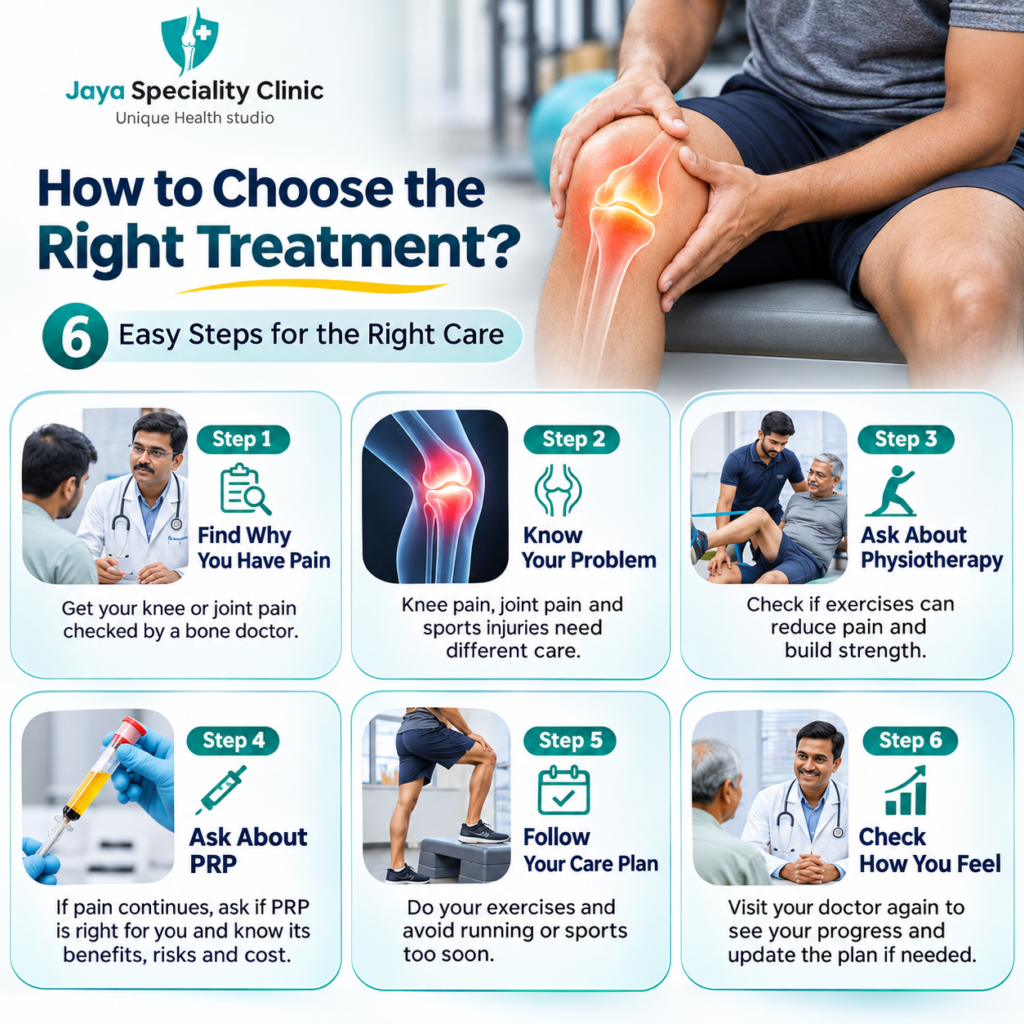
Here are six easy steps to help you choose the right care.
Step 1: Find Why You Have Pain
Do not guess why your knee or joint hurts. Visit a bone doctor and get it checked.
Step 2: Know Your Problem
Knee pain, joint pain, and sports injuries are not the same. Each one may need a different kind of care.
Step 3: Ask About Physiotherapy
Ask your doctor if easy exercises can help lower your pain and make your muscles strong.
Step 4: Ask About PRP
If your pain does not get better, ask your doctor if PRP is right for you.
Ask about its good points, side effects, and cost before you start.
Step 5: Follow Your Care Plan
Do your exercises as your doctor tells you. Do not start running, jumping, or playing sports too soon.
Step 6: Check How You Feel
Visit your doctor again to see if you are getting better.
Your doctor may change your care plan if needed.
Is PRP Treatment Safe?
PRP is made from your own blood. But it can still have some side effects.
You may have:
- Pain where the shot is given.
- A little swelling.
- Blue or dark marks on the skin.
- More pain for a short time.
- Infection, but this is rare.
Before PRP treatment, tell your doctor about the medicines you take and any health problems you have.
The doctor will check if PRP is right for you.
When Should You See a Bone Doctor?
Do not leave joint pain without care.
Visit a bone doctor if:
- Your knee pain does not get better.
- You find it hard to walk.
- Your knee or joint keeps swelling.
- You have pain after playing sports.
- Your joint feels weak.
- You find it hard to do your daily work.
- Your pain stops you from doing normal things.
The doctor will check your body, find the cause of your pain, and tell you what care you may need.
About Jaya Speciality Clinic
Jaya Speciality Clinic is in West Mambalam, Chennai.
The clinic helps people with knee pain, joint pain, sports injuries, ligament problems, and other bone and joint problems.
The clinic is led by Dr. Balachandar M, MBBS, MS (Orthopaedics). He is also an Associate Consultant at Apollo Hospitals, Greams Road, Chennai.
People can visit the clinic to ask about PRP treatment, knee pain, tendon pain, and other joint problems.
The doctor checks each person and gives care based on their health problem.
Care may include physiotherapy, medicines, PRP shots, or an operation if needed.
Clinic Details:
- Clinic Name: Jaya Speciality Clinic
- Address: 18, Kodambakkam Road, Mettupalayam, West Mambalam, Chennai – 600033.
- Phone: 94450 32227
- Website: https://www.jayaspecialityclinic.com/
- PRP Treatment Page: https://www.jayaspecialityclinic.com/prp-treatment-in-chennai.php
Frequently Asked Questions
No, not always. PRP may help some people with joint pain. Physiotherapy helps make muscles strong and helps the body move better. The right care depends on your problem.
No. PRP cannot take the place of exercises. Many people need physiotherapy to make their muscles strong and move well.
PRP may help some people with knee pain. But it does not help everyone. Visit a doctor to check if this care is right for you.
The number of shots depends on your knee or joint problem. Your doctor will tell you how many you may need.
The cost may change from one clinic to another. It also depends on how many shots you need. Call the clinic to ask about the price.
Yes, but you must wait until your doctor says it is safe. Your doctor will tell you when to start your exercises.
It is different for each person. Some people may feel better after a few weeks. Others may take more time. Some people may not get enough help from it.
Conclusion
PRP and physiotherapy are two ways to help people with joint pain.
PRP is made from your own blood. It may help some people with knee pain and tendon problems.
Physiotherapy uses easy exercises to make your muscles strong and help your body move better.
One is not always better than the other. Some people may need only physiotherapy. Others may need PRP along with exercises.
First, find out why you have pain. Visit a bone doctor and ask which care is right for you.
Remember, a shot is not always the best way to feel better. The right care can help you walk, move, and do your daily work with less pain.
Read more
PRP Therapy Side Effects and Recovery: What You Should Know
PRP Treatment in Chennai: Cost, Benefits and Recovery
PRP for Ligament and Tendon Injuries: Can It Support Natural Healing?